From the ACE database. Researched and checked against published sources.
Adolf Hitler
1889 to 1945, leader of the Nazi Party from 1921 and dictator of Germany from 1933 until his suicide in Berlin in April 1945
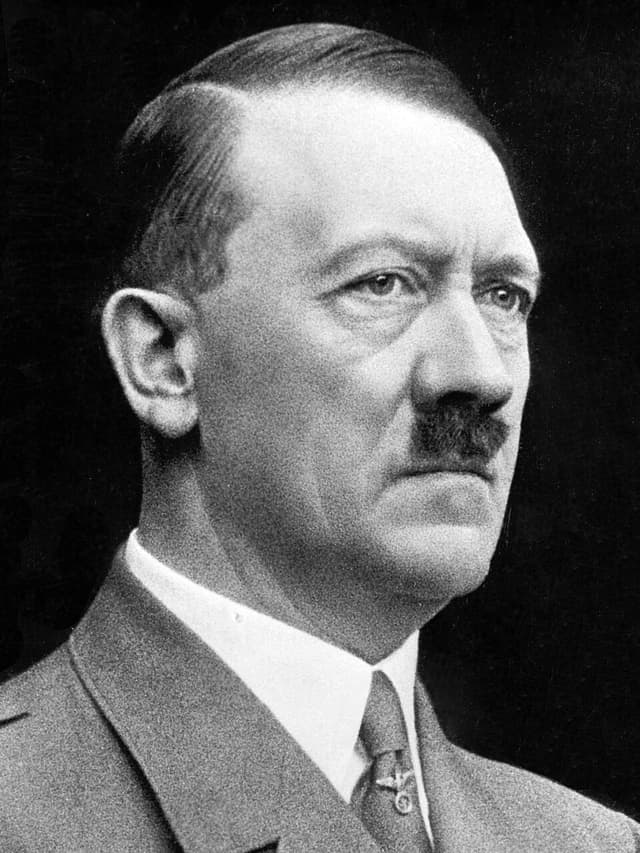
Unknown author, CC BY-SA 3.0 de, via Wikimedia Commons
81/100
ACE Score: 81/100
High on the scale. An index, not a percentage.
95High
How total and coercive the leader’s power was.
67Medium
How devoted to and dependent on the leader followers became.
80High
How hard it was to leave.
:Systems like this tend to be brought down from outside once their violence meets a stronger force.
Scores are an interpretation of published sources using the ACE scoring guide, not findings of fact. Inclusion does not classify anyone as a cult. Disclaimer
Hitler led a fringe nationalist party to power in 1933 and turned Germany into a one-party dictatorship within months. His regime used propaganda, police terror and a cult of the Führer to demand total loyalty. It started the Second World War in Europe and murdered about six million Jews in the Holocaust, along with Roma, disabled people, Soviet prisoners and many others. The regime collapsed with military defeat in 1945.
In academic terms, the calibration case for outward-directed closure: very high epistemic and existential closure, with devotion channelled into a racial community whose violence was aimed at defined outsiders and at other nations.
Where scholars disagree
The case that the framework fits
Scholars of political religion such as Emilio Gentile and Michael Burleigh argue that Nazism offered salvation, rituals and a messiah figure, much like a high-demand cult. Kershaw's 'Hitler myth' shows how much the regime relied on personal devotion to the leader.
The case that it does not fit, or overstates
Structural historians such as Hans Mommsen stressed competing agencies and 'cumulative radicalisation' rather than one man's control. Most Germans were not cult members but citizens who conformed out of opportunism, fear or nationalism.
The five walls
8.6 of 10
- 9
1.
Who decides what is real?
Joseph Goebbels' propaganda ministry and the Reich Chamber of Culture controlled press, radio and the arts from 1933. From 1939 listening to foreign radio was a crime, and some people were executed for spreading what they heard.
- 8
2.
Are friends and family outside the group cut off?
A December 1936 law made the Hitler Youth the only permitted youth organisation, and a March 1939 decree made service in it compulsory. The regime encouraged children and neighbours to report disloyal talk, and the 1935 Nuremberg Laws banned marriage and sex between Jews and other Germans.
- 8
3.
How hard is it to physically leave?
The Gestapo and concentration camps removed opponents from society from 1933. Emigration was possible but costly in the 1930s, and Jewish emigration was banned outright in October 1941.
- 8
4.
Is an apocalypse or a destined triumph always near?
Nazi ideology framed history as a final racial struggle in which Germany would either win living space or perish. Hitler repeatedly predicted the 'annihilation of the Jewish race in Europe' if war came, as in his Reichstag speech of 30 January 1939.
- 10
5.
Does the group decide who deserves to live?
Jews, Roma and others were defined as racial enemies and murdered systematically in the Holocaust. The regime also killed around 200,000 to 300,000 disabled people in its 'euthanasia' programmes.
Debt, dependence and harm
7 of 10, high
How much do followers feel they owe?
From August 1934 soldiers and officials swore a personal oath of loyalty to Hitler. Careers in the civil service, universities and professions depended on political reliability, and many ordinary Germans took part in or profited from persecution.
5 of 10, medium
How far does everything rest on one person?
A large state bureaucracy, army and party apparatus kept functioning, but they competed with one another and ultimately answered to Hitler's will. There was no working succession procedure, and the regime did not survive his death.
+10, mostly outsiders
When the system turns violent, where does the harm go?
The regime waged wars of aggression across Europe and carried out genocide against Jews and Roma, all of which counts as outward. Inward violence against its own movement, such as the killing of SA leaders and others in the 'Night of the Long Knives' of June 1934 (at least 85 dead), was small by comparison.
Methods of control
Specific techniques from the historical record that kept followers loyal and the bubble sealed.
- 01Führer cult and mass rallies
- 02Propaganda monopoly over press, radio and film
- 03Gestapo surveillance and concentration camps
- 04Compulsory youth organisations
- 05Personal loyalty oath for soldiers and officials
- 06Racial laws defining an enemy outgroup
- 07Rewards and careers for complicity
Against the reference cases
State power, violence aimed outward
Compared with Hitler
This is the reference case for regimes in ACE.
A sealed group, violence aimed inward
Compared with Jones
Both leaders demanded personal devotion and framed their followers as facing a final struggle, but Jones turned violence inward on his own community while Hitler turned it outward on defined enemies and other nations.
Through the theorists
Hitler is a textbook charismatic leader whose authority rested on a claimed mission, and who resisted the rules that would have routinised it.
In The Origins of Totalitarianism, Nazism is a movement that uses ideology and terror to destroy independent social bonds and make people interchangeable.
Kershaw
Officials 'worked towards the Führer', anticipating what Hitler wanted, so radical policy emerged from below as well as from orders.
Key sources
Strong evidence base
- Kershaw, Ian (1998). Hitler, 1889–1936: Hubris.
- Kershaw, Ian (1987). The 'Hitler Myth': Image and Reality in the Third Reich.
- Evans, Richard J. (2005). The Third Reich in Power.
Caveats
Scores reflect the peak years 1938 to 1944. Control in 1933 to 1934 was much looser, and the degree of public belief in the regime, as opposed to conformity, is still debated. On the vector, the Holocaust, the murder of Roma, Soviet prisoners of war and occupied civilians, the 'euthanasia' killings of disabled people the regime placed outside the national community, and the persecution of political opponents all count as outward. Purges of the movement itself, such as the 1934 killings, count as inward and were small. German military and civilian war deaths followed from the war the regime started rather than from violence aimed at its own base. These scores are the rubric's calibration anchor.
Cite this profile
Koziol, T. (2026). Adolf Hitler. In ACE: Authority, Cult & Exit (Version 1.1, pilot database). Ceraluna Labs. https://cultornot.com/leader/adolf-hitler