From the ACE database. Researched and checked against published sources.
Huey Long
1893 to 1935, governor of Louisiana from 1928 to 1932 and US senator from 1932 until his assassination in 1935
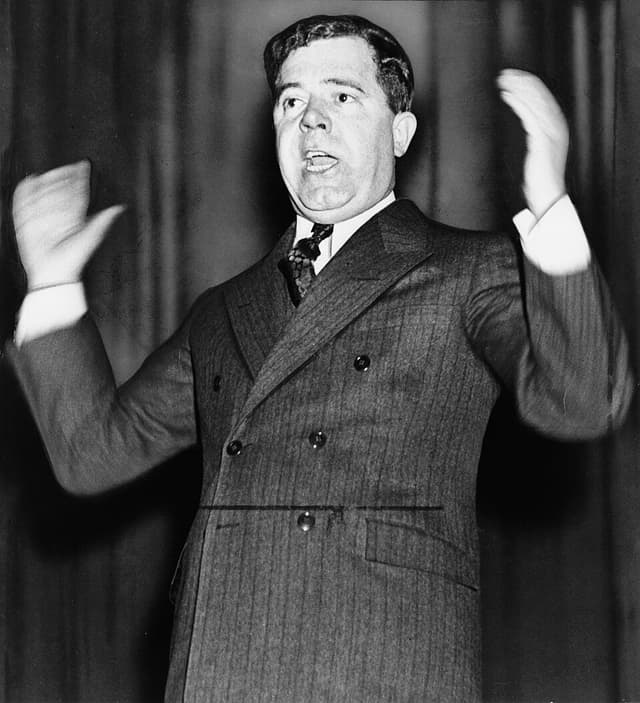
Uncredited news photographer., Public domain, via Wikimedia Commons
22/100
ACE Score: 22/100
Low on the scale. An index, not a percentage.
25Low
How total and coercive the leader’s power was.
37Low
How devoted to and dependent on the leader followers became.
5Low
How hard it was to leave.
(rule-based):Pattern: walls low enough (Bubble Score under 5) for followers to leave fairly easily. A label for these scores, not a forecast. The summary and caveats describe what actually happened.
Scores are an interpretation of published sources using the ACE scoring guide, not findings of fact. Inclusion does not classify anyone as a cult. Disclaimer
Huey Long was a Louisiana politician elected governor in 1928 on promises of roads, schools and free textbooks. He survived an impeachment attempt in 1929 and built a political machine that controlled the legislature, state jobs and police. As a senator he launched the national Share Our Wealth movement to cap large fortunes. In 1934 and 1935 he pushed through laws that gave him wide control over local government, and he was shot dead in the state capitol in 1935.
In academic terms, long concentrated power within a federal democracy using patronage and legislative control, but courts, a free national press and elections limited closure.
Where scholars disagree
The case that the framework fits
Critics at the time and Brinkley later describe a 'dictator of Louisiana' who controlled the legislature and state police, punished opponents with job losses and tried to tax hostile newspapers.
The case that it does not fit, or overstates
Williams and others stress that Long won repeated popular elections, built roads, schools and hospitals for poor voters, faced a hostile press and federal courts, and that elections continued throughout his rule.
The five walls
1.6 of 10
- 3
1.
Who decides what is real?
Long ran his own newspaper and radio speeches, and a 1934 tax on large newspapers aimed at hostile papers. The Supreme Court struck down the tax in Grosjean v. American Press Co. in 1936.
- 1
2.
Are friends and family outside the group cut off?
No interference with family life is documented.
- 0
3.
How hard is it to physically leave?
Residents moved freely within and out of Louisiana.
- 2
4.
Is an apocalypse or a destined triumph always near?
His 'Every Man a King' message promised a fair share for all. It was reformist, not apocalyptic.
- 2
5.
Does the group decide who deserves to live?
Opponents were fired from state jobs, attacked in speeches and pressured by state police. No killings by his machine are documented.
Debt, dependence and harm
3 of 10, low
How much do followers feel they owe?
State employees paid a share of their salaries into the machine's 'deduct box' fund, and jobs depended on loyalty.
6 of 10, medium
How far does everything rest on one person?
His machine and family continued after his death, with Earl Long and others winning office. Courts and federal institutions remained outside his control.
0, little harm, or balanced
When the system turns violent, where does the harm go?
No significant violence by Long's side is documented. He was himself shot in 1935, by Carl Weiss according to most accounts, and Weiss was killed on the spot by Long's bodyguards.
Methods of control
Specific techniques from the historical record that kept followers loyal and the bubble sealed.
- 01Patronage control of state jobs
- 02Salary kickbacks to a political fund
- 03Special legislative sessions passing his bills
- 04Own newspaper and radio broadcasts
- 05Share Our Wealth clubs
- 06Use of state police against opponents
Against the reference cases
State power, violence aimed outward
Compared with Hitler
Contemporaries feared Long as an American Hitler, but he worked within a federal constitution and lost legal fights in federal court.
A sealed group, violence aimed inward
Compared with Jones
No comparison of group control; his followers were voters, not members of a closed community.
Through the theorists
Charisma combined with a patronage machine, a mix of personal and legal authority.
Key
V. O. Key described his machine as a rare case of bifactional, issue-based politics in the one-party South.
Mudde and Rovira Kaltwasser
A clear example of left populism dividing 'the people' from 'the elite'.
Key sources
Strong evidence base
- Williams, T. Harry (1969). Huey Long.
- Brinkley, Alan (1982). Voices of Protest: Huey Long, Father Coughlin, and the Great Depression.
Caveats
His power peaked in 1934 to 1935, shortly before his death. Opinion divides sharply between reformer and demagogue readings.
Cite this profile
Koziol, T. (2026). Huey Long. In ACE: Authority, Cult & Exit (Version 1.1, pilot database). Ceraluna Labs. https://cultornot.com/leader/huey-long