From the ACE database. Researched and checked against published sources.
John Africa
1931 to 1985, born Vincent Leaphart, founded MOVE in Philadelphia in the early 1970s and died in the 1985 police bombing of the group's house
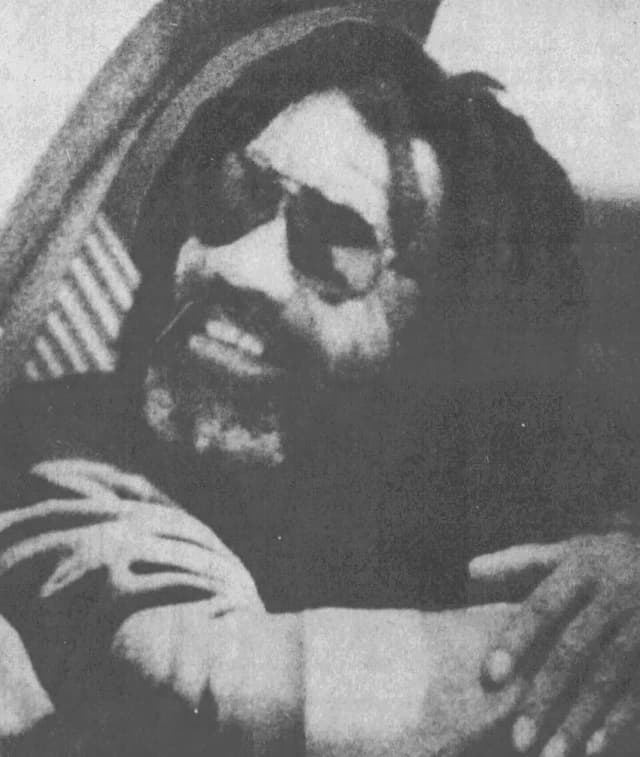
Unknown author, Public domain, via Wikimedia Commons
54/100
ACE Score: 54/100
Medium on the scale. An index, not a percentage.
50Medium
How total and coercive the leader’s power was.
57Medium
How devoted to and dependent on the leader followers became.
55Medium
How hard it was to leave.
(rule-based):Pattern: a closed system with little institutional restraint, where harm was aimed mainly at its own people. A label for these scores, not a forecast. The summary and caveats describe what actually happened.
Scores are an interpretation of published sources using the ACE scoring guide, not findings of fact. Inclusion does not classify anyone as a cult. Disclaimer
John Africa, born Vincent Leaphart, founded MOVE in Philadelphia, a mostly Black communal group that rejected technology, modern medicine and government and ate a raw diet. Members took the surname Africa. A 1978 standoff in Powelton Village ended with police officer James Ramp shot dead and 16 police and firefighters injured; nine members were convicted of third-degree murder, though they denied firing the fatal shot, and officers were filmed beating member Delbert Africa. On 13 May 1985, after years of neighbour complaints, police tried to serve warrants, said they were fired on from the house, and after a long gun battle dropped a bomb on the MOVE house on Osage Avenue and officials let the fire burn. Eleven people died, including John Africa and five children, and 61 homes were destroyed. A city commission called the bombing 'unconscionable' and said race played a part.
In academic terms, mOVE shows moderate closure built on a prophet's teaching and communal living, with the group's own violence limited and disputed. The great majority of deaths were inflicted on MOVE by the city, which makes the vector a case of state violence against a high-tension group rather than violence by it.
Where scholars disagree
The case that the framework fits
Neighbours, former members and journalists described a prophet whose teaching could not be questioned, children kept from school and medicine, and a fortified house, which fit features of a high-control group.
The case that it does not fit, or overstates
Evans argues MOVE was a genuine new religion and a Black radical movement whose clash with Philadelphia grew from policing and racism. The city commission found that the bombing would likely not have happened in a comparable white neighbourhood, and placing MOVE beside violent cults risks blaming victims of state violence.
The five walls
5 of 10
- 5
1.
Who decides what is real?
John Africa's teaching, collected in 'The Guidelines', was treated as the truth about natural law, and schools, doctors and media were rejected as parts of 'the system'. Evans describes it as a religious worldview in which John Africa held prophetic status.
- 6
2.
Are friends and family outside the group cut off?
Members took the surname Africa, lived communally and raised children collectively outside schools. Relatives who opposed the group were often cut off.
- 5
3.
How hard is it to physically leave?
Members lived in group houses, and by 1985 the Osage Avenue house was fortified with a rooftop bunker. Adults could and did leave, but children had no independent exit.
- 4
4.
Is an apocalypse or a destined triumph always near?
MOVE taught that industrial society was destroying life and was doomed. This shaped daily practice but set no dated end.
- 5
5.
Does the group decide who deserves to live?
Members cursed neighbours and officials over loudspeakers for long periods and armed themselves in 1978 and 1985. Officer James Ramp was killed in 1978, a death MOVE members still dispute causing.
Debt, dependence and harm
6 of 10, medium
How much do followers feel they owe?
Members gave up jobs, modern medicine and private property for communal life and a raw diet. Children were raised without schooling or routine medical care.
7 of 10, high
How far does everything rest on one person?
John Africa held the role of founder and teacher, with others acting as spokespeople. After his death in 1985 the group survived in small form around survivors and imprisoned members.
+1, little harm, or balanced
When the system turns violent, where does the harm go?
Violence by MOVE members was aimed outward and limited: the 1978 killing of Officer Ramp, for which nine members were convicted but which they dispute, injuries to other officers, and gunfire police reported in 1985. The 11 deaths in the 1985 police bombing were caused by the city, not MOVE, so they are not counted here.
Methods of control
Specific techniques from the historical record that kept followers loyal and the bubble sealed.
- 01Teaching of a single prophet as natural law
- 02Shared surname and communal identity
- 03Rejection of schools, medicine and technology
- 04Collective child-rearing outside state institutions
- 05Loudspeaker confrontation with neighbours and city
- 06Fortified housing during standoffs
Against the reference cases
State power, violence aimed outward
Compared with Hitler
There is no meaningful comparison: MOVE had a few dozen members, no programme of violence against outsiders, and suffered state violence itself.
A sealed group, violence aimed inward
Compared with Jones
Both were Black-majority communal groups that ended in mass death, but Jonestown's deaths were ordered by its leader while the MOVE deaths followed a police bombing.
Through the theorists
Prophetic charisma with almost no routinisation; the group shrank sharply after the founder's death.
Wagner-Pacifici
She shows how the city's language framed MOVE as a military enemy rather than as residents, which made the bombing thinkable.
Wallace
A revitalization movement that rejected modern society and sought a return to natural law.
Key sources
Moderate evidence base
- Philadelphia Special Investigation Commission (1986). The Findings, Conclusions and Recommendations of the Philadelphia Special Investigation Commission.
- Wagner-Pacifici, Robin (1994). Discourse and Destruction: The City of Philadelphia versus MOVE.
- Evans, Richard Kent (2020). MOVE: An American Religion.
- Boyette, Michael, with Randi Boyette (1989). Let It Burn! The Philadelphia Tragedy.
Caveats
The vector leaves out the 1985 bombing because it was violence by the city against MOVE: police fired more than 10,000 rounds, dropped an explosive on an occupied house and let the fire burn, killing six adults and five children. The Philadelphia Special Investigation Commission (1986) found the bombing 'unconscionable', called the mayor 'grossly negligent' for not stopping the operation with children inside, and said racism played a role. No city official was criminally charged, while survivor Ramona Africa served seven years for riot and conspiracy; a 1996 federal jury awarded her and relatives of two victims $1.5 million, and a 2005 jury awarded displaced neighbours $12.83 million. Evidence about internal life comes from hostile and sympathetic sources alike, and MOVE disputes the 1978 verdict.
Cite this profile
Koziol, T. (2026). John Africa. In ACE: Authority, Cult & Exit (Version 1.1, pilot database). Ceraluna Labs. https://cultornot.com/leader/john-africa