From the ACE database. Researched and checked against published sources.
Pol Pot
1925 to 1998, secretary of the Communist Party of Kampuchea and ruler of Democratic Kampuchea from April 1975 until the Vietnamese invasion of January 1979
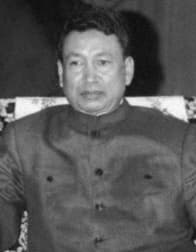
Unknown author, Attribution, via Wikimedia Commons
94/100
ACE Score: 94/100
High on the scale. An index, not a percentage.
100High
How total and coercive the leader’s power was.
83High
How devoted to and dependent on the leader followers became.
100High
How hard it was to leave.
:Systems like this tend to be brought down from outside once their violence meets a stronger force.
Scores are an interpretation of published sources using the ACE scoring guide, not findings of fact. Inclusion does not classify anyone as a cult. Disclaimer
Pol Pot's Khmer Rouge took Phnom Penh in April 1975 and emptied the cities within days. They abolished money, markets, schools, religion and private property, and forced the whole population into rural labour cooperatives. Between about 1.5 and 2 million people, roughly a fifth of the population, died from execution, starvation, overwork and disease in under four years. Orders came from 'Angkar', the Organisation, and the party's existence and Pol Pot's role as its leader were not publicly confirmed until September 1977.
In academic terms, democratic Kampuchea is the most complete closure in this batch: a whole country sealed like a compound, with survival entirely dependent on an anonymous organisation that killed both outsiders and its own cadres.
Where scholars disagree
The case that the framework fits
Kiernan argues that race and central control from Pol Pot's inner circle drove the killings. The anonymous 'Angkar', the confessions at S-21 and the abolition of family life resemble a sealed cult at national scale.
The case that it does not fit, or overstates
Michael Vickery and others stressed peasant revenge, local commanders and the effects of the American bombing rather than a single plan. Chandler and Short note that the leadership cult around Pol Pot himself was minimal, so this is not a classic personality cult.
The five walls
9.6 of 10
- 10
1.
Who decides what is real?
There was no postal service, no independent press, and almost no contact with the outside world. Radio carried only party messages, and people were told that Angkar 'has the eyes of a pineapple' and saw everything.
- 10
2.
Are friends and family outside the group cut off?
Family life was broken up: people ate in communal kitchens, children were often separated into youth units, and the party arranged mass marriages. Children were trained to spy on and report adults.
- 10
3.
How hard is it to physically leave?
The cities were evacuated in 1975 and people could not move between cooperatives without permission. Borders were closed and mined, and those caught fleeing were often killed.
- 8
4.
Is an apocalypse or a destined triumph always near?
The regime treated 1975 as 'Year Zero', a total break with the past, and demanded a 'super great leap forward' in rice production. Constant warnings of Vietnamese and CIA plots kept the population in a permanent state of war.
- 10
5.
Does the group decide who deserves to live?
'New people' from the cities, ethnic Vietnamese, Cham Muslims and suspected traitors were killed in large numbers. In 2018 the Cambodia tribunal convicted Nuon Chea of genocide against the Vietnamese and the Cham, and Khieu Samphan of genocide against the Vietnamese.
Debt, dependence and harm
10 of 10, high
How much do followers feel they owe?
All private property was abolished and every person depended on Angkar for food rations. Tribunal prosecutors listed about 18,000 prisoners at the S-21 prison, almost all of whom were tortured into written confessions and then killed.
7 of 10, high
How far does everything rest on one person?
A secret party structure with zones and committees existed, but it worked through fear and repeated purges. Senior cadres and whole regional armies were wiped out on suspicion of treason, and there was no succession plan.
+3, mostly outsiders
When the system turns violent, where does the harm go?
Outward: urban 'new people', ethnic Vietnamese, Chinese and Cham, and cross-border raids into Vietnam such as the April 1978 Ba Chúc massacre of about 3,000 civilians. Inward: starvation and overwork among rural 'base people' and purges that wiped out many Khmer Rouge cadres and regional armies, so the net direction is only moderately outward.
Methods of control
Specific techniques from the historical record that kept followers loyal and the bubble sealed.
- 01Evacuation of cities and forced rural labour
- 02Abolition of money, markets and private property
- 03Communal eating and separation of families
- 04Anonymous authority of 'Angkar'
- 05Confession under torture at S-21
- 06Continuous purges of cadres
- 07Sealed borders and no outside contact
Against the reference cases
State power, violence aimed outward
Compared with Hitler
Both regimes carried out genocide against defined groups, but the Khmer Rouge killed a far larger share of its own population and many of its own members.
A sealed group, violence aimed inward
Compared with Jones
Democratic Kampuchea resembled Jonestown as a sealed settlement where survival depended on the group, but at the scale of a whole nation over four years.
Through the theorists
Authority was claimed by an impersonal 'Organisation' rather than an openly charismatic person, an unusual mix of concealed charisma and secret bureaucracy.
The demand for total purity, confession and the 'dispensing of existence' to those labelled impure fits Lifton's model of totalism closely.
Cooperatives worked like total institutions in which every hour of life was scheduled and supervised.
Key sources
Strong evidence base
- Kiernan, Ben (1996). The Pol Pot Regime: Race, Power, and Genocide in Cambodia under the Khmer Rouge, 1975–79.
- Chandler, David P. (1992). Brother Number One: A Political Biography of Pol Pot.
- Short, Philip (2005). Pol Pot: Anatomy of a Nightmare.
Caveats
Death toll estimates range from about 1.5 to over 2 million, and how many were executions rather than famine deaths is debated. Death rates were highest among urban 'new people' and ethnic Chinese, Vietnamese and Cham (outward), but rural Khmer were the majority of the population, and hundreds of thousands of them died from hunger, overwork and purges of cadres and the Eastern Zone (largely inward, although Eastern Zone people were branded traitors). Conditions varied a lot between regions. Pol Pot led an insurgency until 1997 and died in 1998 without trial.
Cite this profile
Koziol, T. (2026). Pol Pot. In ACE: Authority, Cult & Exit (Version 1.1, pilot database). Ceraluna Labs. https://cultornot.com/leader/pol-pot