From the ACE database. Researched and checked against published sources.
Saddam Hussein
1937 to 2006, leading figure of the Iraqi Ba'th regime from 1968 and president from 1979 until the US-led invasion in 2003; executed in 2006
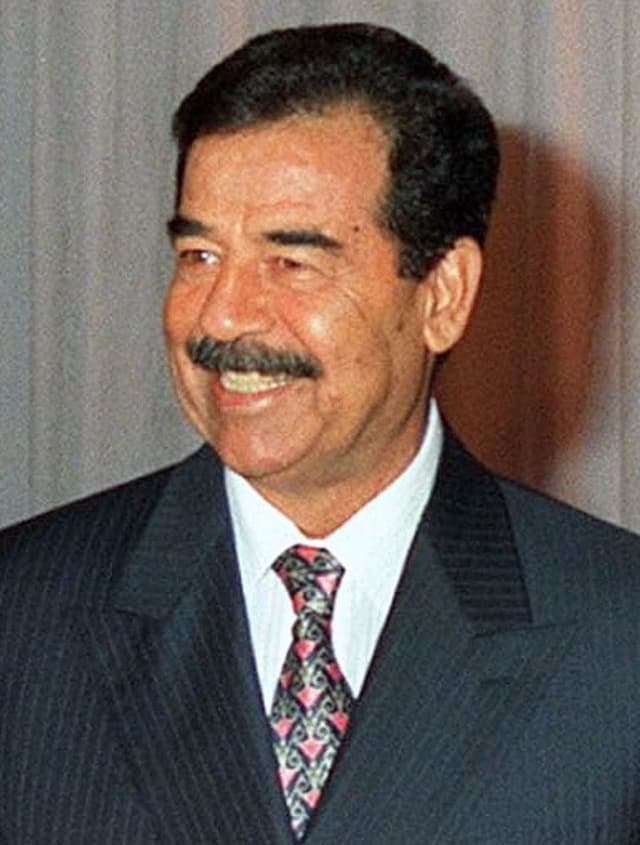
Iraqi News Agency, Public domain, via Wikimedia Commons
77/100
ACE Score: 77/100
High on the scale. An index, not a percentage.
95High
How total and coercive the leader’s power was.
60Medium
How devoted to and dependent on the leader followers became.
75High
How hard it was to leave.
(rule-based):Pattern: a closed system with little institutional restraint, where harm was aimed mainly at outsiders. A label for these scores, not a forecast. The summary and caveats describe what actually happened.
Scores are an interpretation of published sources using the ACE scoring guide, not findings of fact. Inclusion does not classify anyone as a cult. Disclaimer
Saddam Hussein rose through the Ba'th Party and became president of Iraq in 1979, starting his rule with a televised purge in which party leaders were named as traitors and taken out to be shot. He built overlapping security agencies and a party network that recruited informers in every neighbourhood. He led Iraq into war with Iran from 1980 to 1988 and invaded Kuwait in 1990. In the 1988 Anfal campaign his forces killed tens of thousands of Kurds, including with chemical weapons at Halabja. He crushed the 1991 uprisings and ruled until the 2003 invasion.
In academic terms, saddam combined a mass party, pervasive surveillance and a leader-cult with genocide and wars of aggression; closure was near total, and complicity was systematically built into party life.
Where scholars disagree
The case that the framework fits
Kanan Makiya described Iraq as a 'republic of fear' in which terror, informers and the cult of Saddam produced near-total control, close to the Stalinist model.
The case that it does not fit, or overstates
Lisa Blaydes and Joseph Sassoon show the regime also relied on rewards, bargaining with groups and uneven reach, and that compliance often reflected material calculation more than belief.
The five walls
7.8 of 10
- 9
1.
Who decides what is real?
All media were state-controlled, satellite dishes were banned, and a 1986 decree set life imprisonment for insulting the president, and death in serious cases. Saddam's portraits and murals covered public space.
- 7
2.
Are friends and family outside the group cut off?
The Ba'th Party recruited children and asked citizens to report on neighbours and relatives, and relatives of deserters and opponents were punished. Party archives studied by Joseph Sassoon document a dense informer system.
- 8
3.
How hard is it to physically leave?
Foreign travel was banned or tightly restricted for most Iraqis for long periods, and leaving required permission and high fees. Kurdish villages were destroyed and their people forcibly moved into camps.
- 5
4.
Is an apocalypse or a destined triumph always near?
The Iran war was framed as 'Saddam's Qadisiyya', a replay of a 7th-century battle, and the 1991 war as 'the Mother of All Battles'. Ba'thist ideology promised an Arab rebirth led by Iraq.
- 10
5.
Does the group decide who deserves to live?
The 1988 Anfal campaign killed between about 50,000 and 100,000 Kurds by Human Rights Watch estimates, and the Halabja gas attack killed between about 3,200 and 5,000 people. Tens of thousands more were killed in crushing the 1991 Shia and Kurdish uprisings.
Debt, dependence and harm
7 of 10, high
How much do followers feel they owe?
Party membership was needed for many careers, and members were expected to inform, attend meetings and sometimes take part in executions. At the 1979 purge, senior party members were made to join the firing squads.
6 of 10, medium
How far does everything rest on one person?
The Ba'th Party and Revolutionary Command Council were real bureaucracies with rules and records, but Saddam overrode them and placed relatives and his home-region clan in key posts. Succession pointed to his sons, not to a procedure.
+10, mostly outsiders
When the system turns violent, where does the harm go?
Saddam launched wars of aggression against Iran in 1980 and Kuwait in 1990 and carried out genocide against Kurds in the Anfal campaign; under the regime rule, the crushing of the 1991 Shia and Kurdish uprisings also counts as outward. Inward violence, such as the 1979 party purge and executions of officers and relatives, was real but small by comparison.
Methods of control
Specific techniques from the historical record that kept followers loyal and the bubble sealed.
- 01Overlapping security agencies watching each other
- 02Ba'th Party informer networks in every neighbourhood
- 03Forced complicity, including participation in executions
- 04Collective punishment of families and communities
- 05Leader-cult in media, murals and schools
- 06Rewards and patronage for loyal tribes and officers
Against the reference cases
State power, violence aimed outward
Compared with Hitler
Saddam is close to the Hitler anchor on violence: genocide against a minority and wars of aggression, though with weaker ideological conviction.
A sealed group, violence aimed inward
Compared with Jones
Like Jones, Saddam made followers complicit in violence to bind them, but his violence was directed mainly at outsiders and minorities rather than at loyal members.
Through the theorists
Overlapping police services, mass informing and the atomisation of society match Arendt's account of totalitarian rule.
Saddam converted a bureaucratic party into an instrument of personal and clan rule, reversing routinization.
Wedeen
Lisa Wedeen's work on Syria suggests that compulsory cult performance worked by making citizens act 'as if' they believed, a reading many apply to Saddam's Iraq.
Key sources
Strong evidence base
- Makiya, Kanan (as Samir al-Khalil) (1989). Republic of Fear: The Politics of Modern Iraq.
- Sassoon, Joseph (2012). Saddam Hussein's Ba'th Party: Inside an Authoritarian Regime.
- Blaydes, Lisa (2018). State of Repression: Iraq under Saddam Hussein.
Caveats
Death toll estimates for Anfal range from about 50,000 to 182,000. On the vector, Anfal, Halabja and the 1991 repression fall on the outward side; the 1979 purge, executions of officers and family members, and the heavy losses of Iraqi conscripts in his wars fall on the inward side, but do not change the net direction. Some early accounts were shaped by exile politics and the run-up to the 2003 war, though captured regime archives have since confirmed much of the repression.
Cite this profile
Koziol, T. (2026). Saddam Hussein. In ACE: Authority, Cult & Exit (Version 1.1, pilot database). Ceraluna Labs. https://cultornot.com/leader/saddam-hussein