From the ACE database. Researched and checked against published sources.
Sun Myung Moon
1920 to 2012, founder of the Unification Church in Seoul in 1954, with peak Western recruitment in the 1970s
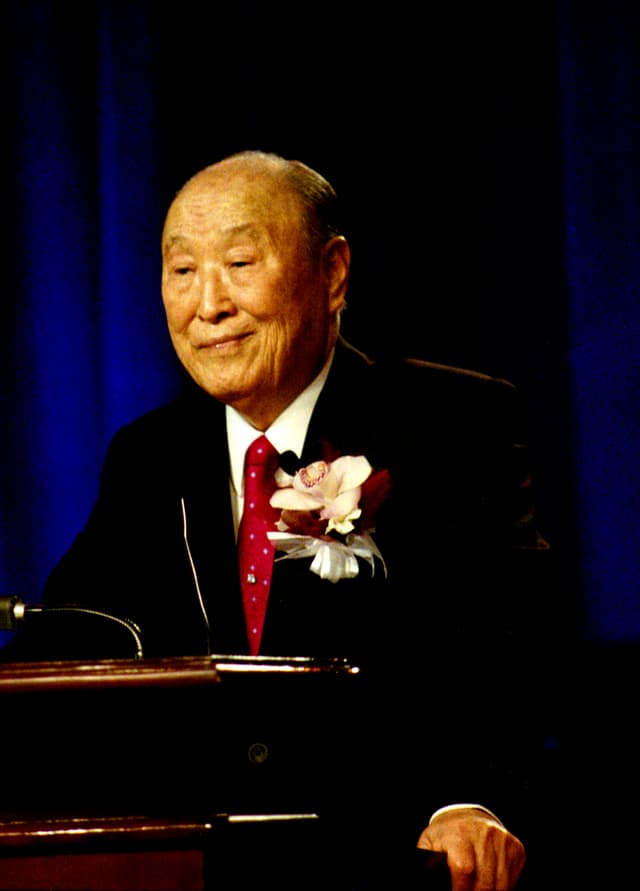
David Roberts, CC BY-SA 3.0, via Wikimedia Commons
48/100
ACE Score: 48/100
Medium on the scale. An index, not a percentage.
40Medium
How total and coercive the leader’s power was.
53Medium
How devoted to and dependent on the leader followers became.
50Medium
How hard it was to leave.
:Systems like this tend to fade as followers drift away or the movement goes mainstream.
Scores are an interpretation of published sources using the ACE scoring guide, not findings of fact. Inclusion does not classify anyone as a cult. Disclaimer
Sun Myung Moon founded the Unification Church in Seoul in 1954 and presented himself as the Lord of the Second Advent who would restore humanity through a sinless 'True Family'. In the 1970s young Western recruits lived in church centres, raised money on the street for long hours and accepted marriage partners chosen by Moon in mass Blessing ceremonies. The movement built a large business, media and political network. Moon served 13 months in a US prison in 1984 and 1985 after a conviction for filing false tax returns and conspiracy and died in 2012.
In academic terms, moon combined moderate epistemic and social closure (arranged marriage, communal fundraising teams) with low spatial and existential closure, so devotion debt rather than coercion carried the binding. Barker's data show that most recruits left of their own accord, which places him well below the destructive cases.
Where scholars disagree
The case that the framework fits
Critics and the anti-cult movement pointed to deceptive front-group recruitment, exhausting fundraising, arranged marriages and the demand that members treat Moon as Messiah as signs of high control. Japanese courts upheld civil claims over coercive donation practices.
The case that it does not fit, or overstates
Barker's study of workshop attendees found no evidence of irresistible 'brainwashing', as the large majority declined or left freely. Bromley and Shupe argued that much hostility came from a moral panic and from deprogrammers who themselves used coercion.
The five walls
4.6 of 10
- 5
1.
Who decides what is real?
The Divine Principle was taught as revealed truth and Moon's word as the final interpretation, and members were encouraged to read negative press as satanic attack. Outside media remained physically available and many members read it.
- 6
2.
Are friends and family outside the group cut off?
Moon matched couples, often of different nationalities, in mass Blessings, and couples were sometimes asked to live apart for years for mission work. Parents' objections were framed as spiritual opposition, though contact with family was not forbidden.
- 4
3.
How hard is it to physically leave?
Full-time members in the 1970s lived in church centres and mobile fundraising teams with money held by the church. Barker found that most people who attended workshops never joined and most who joined left within a few years.
- 5
4.
Is an apocalypse or a destined triumph always near?
Teaching held that the Messiah had come and that the world was in a providential period of restoration, divided into fixed multi-year courses with providential deadlines. This urgency shaped daily fundraising and witnessing.
- 3
5.
Does the group decide who deserves to live?
Communism was described as a satanic force and outsiders as living in the fallen world. There is no documented doctrine of violence against critics or defectors.
Debt, dependence and harm
6 of 10, medium
How much do followers feel they owe?
Full-time members gave up studies and careers, fundraised for many hours a day and paid 'indemnity' through sacrifice. Ordinary followers in Japan were later found by courts to have been pressed into very large donations through spiritual sales.
5 of 10, medium
How far does everything rest on one person?
The church had national leaders, businesses and seminaries, but authority flowed from Moon and his family. After his death the movement split between his widow Hak Ja Han and several sons, showing that succession was unresolved.
0, little harm, or balanced
When the system turns violent, where does the harm go?
There is little documented lethal violence by the movement against members or outsiders during Moon's leadership.
Methods of control
Specific techniques from the historical record that kept followers loyal and the bubble sealed.
- 01Messianic claim that only Moon can restore humanity
- 02Arranged cross-cultural marriages in mass Blessings
- 03Communal centres and mobile fundraising teams
- 04Indemnity theology that links sacrifice to salvation
- 05Front organisations that delayed disclosure of affiliation
- 06Framing family opposition as satanic
Against the reference cases
State power, violence aimed outward
Compared with Hitler
Like Hitler, Moon fused a world-historical mission with anti-communism and built a large organisation, but he had no state power and used no terror.
A sealed group, violence aimed inward
Compared with Jones
Moon shared Jones's messianic self-presentation and communal living, but his movement had no sealed enclave, no armed control and no turn to mass death.
Through the theorists
Moon's charisma was partly routinised early into a church bureaucracy and business network, yet the theology of the True Family kept authority hereditary and personal.
Joining was a choice shaped by social pressure rather than mind control, as shown by high voluntary exit rates.
Bromley and Shupe
Public alarm about the 'Moonies' is best read as a social conflict between a high-tension sect and families, media and deprogrammers.
Key sources
Strong evidence base
- Barker, Eileen (1984). The Making of a Moonie: Choice or Brainwashing?.
- Bromley, David G., and Anson D. Shupe (1979). 'Moonies' in America: Cult, Church, and Crusade.
- Chryssides, George D. (1991). The Advent of Sun Myung Moon: The Origins, Beliefs and Practices of the Unification Church.
Caveats
Scores describe Western full-time membership in the 1970s; later decades were less communal. Evidence comes from both sympathetic scholars and hostile ex-member accounts, and the Japanese donation cases date mostly from after the 1980s.
Cite this profile
Koziol, T. (2026). Sun Myung Moon. In ACE: Authority, Cult & Exit (Version 1.1, pilot database). Ceraluna Labs. https://cultornot.com/leader/sun-myung-moon