From the ACE database. Researched and checked against published sources.
William Luther Pierce
1933 to 2002, founder and leader of the National Alliance, based from 1985 on a compound in Pocahontas County, West Virginia
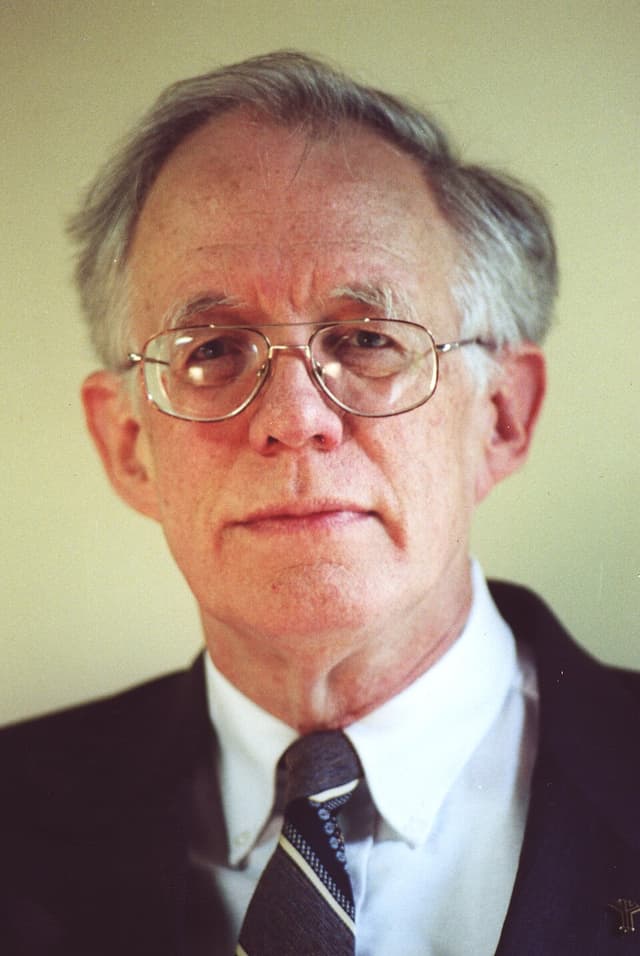
Robert Hartnell, CC BY-SA 3.0, via Wikimedia Commons
44/100
ACE Score: 44/100
Medium on the scale. An index, not a percentage.
50Medium
How total and coercive the leader’s power was.
57Medium
How devoted to and dependent on the leader followers became.
25Low
How hard it was to leave.
(rule-based):Pattern: walls low enough (Bubble Score under 5) for followers to leave fairly easily. A label for these scores, not a forecast. The summary and caveats describe what actually happened.
Scores are an interpretation of published sources using the ACE scoring guide, not findings of fact. Inclusion does not classify anyone as a cult. Disclaimer
Pierce was a former physics professor who joined Rockwell's circle in the 1960s and founded the National Alliance in 1974. Under a pseudonym he wrote 'The Turner Diaries' (1978), a novel describing a race war, which inspired violent groups such as The Order in the 1980s and was linked to the 1995 Oklahoma City bombing. He also founded a small religion, Cosmotheism, and ran a compound in West Virginia. The National Alliance declined quickly after he died in 2002.
In academic terms, pierce ran a low-closure organisation but spread a highly apocalyptic, dehumanising ideology; his impact came through inspiring violence by others, not through controlling members.
Where scholars disagree
The case that the framework fits
Zeskind and Belew show Pierce as a central ideologue whose apocalyptic fiction shaped a violent movement, and whose Cosmotheism gave his followers a quasi-religious frame.
The case that it does not fit, or overstates
Griffin's portrait, written with access to Pierce, presents him as an intellectual more than a cult figure, and the Alliance made few demands on members and had no means to stop them leaving.
The five walls
4.4 of 10
- 4
1.
Who decides what is real?
Pierce's writings and radio broadcasts were the Alliance's doctrine, and mainstream media were denounced as enemy-controlled, but members lived in ordinary society.
- 3
2.
Are friends and family outside the group cut off?
Members kept their jobs and families; only a small staff lived at the West Virginia compound.
- 2
3.
How hard is it to physically leave?
The compound housed staff only, and members came and went freely.
- 7
4.
Is an apocalypse or a destined triumph always near?
Pierce taught that a racial war and the collapse of the existing order were coming, a vision set out in 'The Turner Diaries'.
- 6
5.
Does the group decide who deserves to live?
His writings dehumanised Jews and non-whites and imagined mass killing; readers inspired by them committed murders, though the Alliance itself did not order killings.
Debt, dependence and harm
3 of 10, low
How much do followers feel they owe?
Members paid dues and bought publications and music; demands on most members were modest.
7 of 10, high
How far does everything rest on one person?
The Alliance had units and paid staff, but it depended on Pierce and split apart within a few years of his death.
+5, mostly outsiders
When the system turns violent, where does the harm go?
The Order, founded in 1983 by Robert Mathews, the Alliance's Pacific Northwest organiser, with other Alliance members, murdered the radio host Alan Berg in 1984, and Timothy McVeigh carried pages of 'The Turner Diaries' when he bombed Oklahoma City in 1995; Pierce ordered neither.
Methods of control
Specific techniques from the historical record that kept followers loyal and the bubble sealed.
- 01Apocalyptic race-war fiction
- 02Radio broadcasts and publications
- 03Cosmotheism as a quasi-religion
- 04Dues-paying membership units
- 05Compound headquarters for staff
- 06White-power music business
Against the reference cases
State power, violence aimed outward
Compared with Hitler
Pierce shared Hitler's racial ideology but had no power over a state or even a large membership.
A sealed group, violence aimed inward
Compared with Jones
Unlike Jones, Pierce did not control his members' daily lives; his influence spread through texts.
Through the theorists
Pierce's authority came from his writing and intellect; it did not transfer to successors.
Michael Barkun
Barkun's work on millennialism helps explain how Pierce's race-war story functioned as a secular apocalypse.
Kathleen Belew
Belew treats 'The Turner Diaries' as a key text that helped organise white-power violence through leaderless resistance.
Key sources
Moderate evidence base
- Griffin, Robert S. (2001). The Fame of a Dead Man's Deeds: An Up-Close Portrait of White Nationalist William Pierce.
- Zeskind, Leonard (2009). Blood and Politics: The History of the White Nationalist Movement from the Margins to the Mainstream.
- Belew, Kathleen (2018). Bring the War Home: The White Power Movement and Paramilitary America.
Caveats
Griffin's biography is sympathetic and has been criticised as uncritical. The link between Pierce's writings and specific attacks is real but indirect, and claims that he received money stolen by The Order were never proved. The vector counts violence his movement inspired, since the rubric scores who was harmed rather than who gave orders, while the existential score stays below 7 because the Alliance did not itself sanction killings.
Cite this profile
Koziol, T. (2026). William Luther Pierce. In ACE: Authority, Cult & Exit (Version 1.1, pilot database). Ceraluna Labs. https://cultornot.com/leader/william-luther-pierce