From the ACE database. Researched and checked against published sources.
G. I. Gurdjieff
c. 1866 to 1949, teaching in Moscow and St Petersburg, then at the Prieuré near Fontainebleau and in Paris
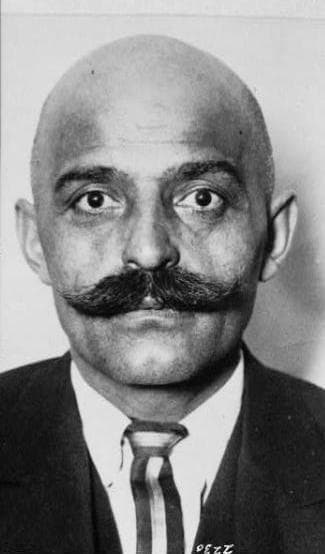
Janet Flanner-Solita Solano papers., Public domain, via Wikimedia Commons
31/100
ACE Score: 31/100
Low on the scale. An index, not a percentage.
25Low
How total and coercive the leader’s power was.
37Low
How devoted to and dependent on the leader followers became.
30Low
How hard it was to leave.
(rule-based):Pattern: walls low enough (Bubble Score under 5) for followers to leave fairly easily. A label for these scores, not a forecast. The summary and caveats describe what actually happened.
Scores are an interpretation of published sources using the ACE scoring guide, not findings of fact. Inclusion does not classify anyone as a cult. Disclaimer
Gurdjieff was an Armenian-Greek spiritual teacher who taught that most people live 'asleep' and need hard inner work to wake up. From 1922 to 1932 he ran a residential institute at the Prieuré near Fontainebleau, where pupils did heavy manual labour, sacred dances and long exercises in self-observation. He was famous for testing and humiliating students and for unpredictable demands. Followers came and went, and several prominent pupils, including P. D. Ouspensky, broke with him and kept teaching on their own.
In academic terms, gurdjieff's circle shows moderate epistemic closure and devotion debt built on a teacher-pupil relationship, with low spatial, temporal and existential closure; it is a demanding school, not a sealed group.
Where scholars disagree
The case that the framework fits
Critics such as Webb describe a teacher who used shock, humiliation and financial pressure to keep pupils dependent, and note that he presented an unverifiable biography and secret lineage.
The case that it does not fit, or overstates
Moore and sympathetic scholars stress that pupils were educated adults who left freely, that former students kept teaching independently, and that the method aimed at self-reliance rather than obedience.
The five walls
2.4 of 10
- 4
1.
Who decides what is real?
Gurdjieff claimed access to hidden ancient knowledge and presented ordinary thinking as 'sleep', so his interpretation was privileged. Pupils still read widely, and Ouspensky's break in 1924 shows that open disagreement was possible.
- 3
2.
Are friends and family outside the group cut off?
Residence at the Prieuré took priority over family life for some pupils, and Gurdjieff fathered children with several followers. Outside ties were not forbidden and many pupils kept careers and families.
- 3
3.
How hard is it to physically leave?
The Prieuré was communal and physically demanding, but residence was voluntary. Pupils such as A. R. Orage and Jean Toomer came and went, and many visitors stayed only weeks or months.
- 1
4.
Is an apocalypse or a destined triumph always near?
The teaching focused on individual awakening, not a coming end. Cosmological writings such as Beelzebub's Tales describe humanity's plight without a dated catastrophe.
- 1
5.
Does the group decide who deserves to live?
Outsiders were described as mechanical or asleep, a mild form of spiritual inferiority. There is no record of threats or violence against critics.
Debt, dependence and harm
4 of 10, medium
How much do followers feel they owe?
Pupils did hard unpaid labour, accepted public humiliation as part of the training, and wealthy followers, many of them American, funded the institute. This is a substantial but voluntary sacrifice.
6 of 10, medium
How far does everything rest on one person?
During his life authority rested wholly on Gurdjieff. After his death in 1949 Jeanne de Salzmann organised Gurdjieff Foundations and societies that still teach the movements and ideas.
0, little harm, or balanced
When the system turns violent, where does the harm go?
No lethal violence is documented. Katherine Mansfield died at the Prieuré in 1923 of tuberculosis she already had, which critics cited but which was not caused by the group.
Methods of control
Specific techniques from the historical record that kept followers loyal and the bubble sealed.
- 01Claim of hidden ancient knowledge
- 02Framing ordinary life as 'sleep'
- 03Deliberate shocks and public humiliation
- 04Hard manual labour and long sacred-dance practice
- 05Financial support from wealthy pupils
- 06Inner circle and graded access to teaching
Against the reference cases
State power, violence aimed outward
Compared with Hitler
Gurdjieff had no state, police or ideology of enemies, so the comparison is almost entirely one of contrast.
A sealed group, violence aimed inward
Compared with Jones
Like Jones he lived among followers in a communal setting and used personal unpredictability, but residents were free to leave and no one was killed by the group.
Through the theorists
A classic case of personal charisma resting on claimed secret knowledge, later routinised by a foundation that preserves practices rather than a living leader.
Stark and Bainbridge
Fits an 'audience' and 'client' cult model shading into a small cult movement, with high costs for an inner core and loose ties for the wider circle.
Shows 'sacred science' and some 'demand for purity', but lacks the milieu control and dispensing of existence of high-control groups.
Key sources
Moderate evidence base
- Moore, James (1991). Gurdjieff: The Anatomy of a Myth.
- Webb, James (1980). The Harmonious Circle: The Lives and Work of G. I. Gurdjieff, P. D. Ouspensky, and Their Followers.
- Ouspensky, P. D. (1949). In Search of the Miraculous: Fragments of an Unknown Teaching.
Caveats
Much of the record comes from devoted pupils or bitter ex-pupils. Control was highest at the Prieuré in 1922 to 1924 and lower later in Paris. His early life story is largely self-reported and unverifiable.
Cite this profile
Koziol, T. (2026). G. I. Gurdjieff. In ACE: Authority, Cult & Exit (Version 1.1, pilot database). Ceraluna Labs. https://cultornot.com/leader/g-i-gurdjieff