From the ACE database. Researched and checked against published sources.
Girolamo Savonarola
1452 to 1498, Dominican prior of San Marco, dominant moral voice in the Florentine republic from 1494 to 1498
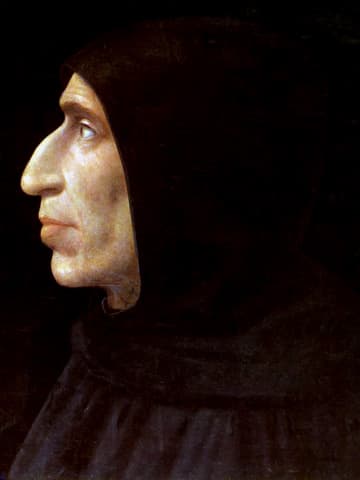
Fra Bartolomeo, Public domain, via Wikimedia Commons
32/100
ACE Score: 32/100
Low on the scale. An index, not a percentage.
35Low
How total and coercive the leader’s power was.
47Medium
How devoted to and dependent on the leader followers became.
15Low
How hard it was to leave.
(rule-based):Pattern: walls low enough (Bubble Score under 5) for followers to leave fairly easily. A label for these scores, not a forecast. The summary and caveats describe what actually happened.
Scores are an interpretation of published sources using the ACE scoring guide, not findings of fact. Inclusion does not classify anyone as a cult. Disclaimer
Girolamo Savonarola was a Dominican friar who preached in Florence that God would punish Italy for its sins. When the French king Charles VIII invaded in 1494 and the Medici fell, many Florentines saw his prophecy confirmed, and he became the leading voice behind the new republic. His followers organised bands of boys to collect luxury goods and gambling tools for the Bonfires of the Vanities in 1497 and 1498. The pope excommunicated him in 1497, and in 1498 he was arrested, tortured and executed by the city government.
In academic terms, savonarola built moral and temporal pressure across a whole city through preaching and youth bands, but worked inside existing institutions. Spatial and existential closure stayed low, and his downfall shows how limited his control was.
Where scholars disagree
The case that the framework fits
A charismatic preacher claimed divine prophecy, mobilised children to police morals, and turned a city toward imminent renewal, with burnings of books and art.
The case that it does not fit, or overstates
Weinstein and Martines show him as a reforming friar within mainstream Catholic and republican politics, supported by many leading citizens. He held no office, could not stop his own arrest, and many historians, and some later saints, regarded him as a sincere reformer.
The five walls
3.2 of 10
- 4
1.
Who decides what is real?
His sermons claimed prophetic insight and attacked secular learning and art, and some books and paintings were burned. Florence remained an open city with rival preachers and strong opposition.
- 3
2.
Are friends and family outside the group cut off?
The fanciulli, boys' bands, went house to house collecting vanities and reportedly reported on adults' behaviour. Family life was otherwise not reorganised.
- 0
3.
How hard is it to physically leave?
Florentines moved freely. Followers were ordinary citizens and friars of San Marco.
- 6
4.
Is an apocalypse or a destined triumph always near?
He preached a coming scourge followed by the renewal of the Church, with Florence as a new Jerusalem. These themes shaped civic life from 1494 to 1497.
- 3
5.
Does the group decide who deserves to live?
Opponents were cast as enemies of God and of the city. In 1497 five men accused of plotting to restore the Medici were executed after he did not speak up for their right of appeal under a law he had backed.
Debt, dependence and harm
3 of 10, low
How much do followers feel they owe?
Followers gave up luxuries, gambling and festive customs and joined processions and fasts. There was no surrender of property.
5 of 10, medium
How far does everything rest on one person?
He operated within the Dominican order and the republic's Great Council, which had authority apart from him. The Piagnoni survived his death as a faction and a devotional tradition.
+1, little harm, or balanced
When the system turns violent, where does the harm go?
Little lethal violence came from his movement; the executions of 1497 were decided by the city government. He was himself the most prominent victim, executed in 1498.
Methods of control
Specific techniques from the historical record that kept followers loyal and the bubble sealed.
- 01Apocalyptic preaching confirmed by political events
- 02Youth bands enforcing morals
- 03Public burnings of luxury goods and art
- 04Processions and collective penance
- 05Framing the city as a chosen New Jerusalem
Against the reference cases
State power, violence aimed outward
Compared with Hitler
Both linked the nation's fate to moral purification, but Savonarola controlled no police or army and was removed by the state he influenced.
A sealed group, violence aimed inward
Compared with Jones
Savonarola never isolated followers or controlled their property; his influence was public and could be withdrawn, as it was in 1498.
Through the theorists
He combined prophetic charisma with the office charisma of a priest and prior, which gave his authority an institutional footing.
Weinstein
Weinstein reads his prophecy as fused with Florentine civic myth, so his authority depended on patriotism as much as religion.
Machiavelli
Machiavelli called him an 'unarmed prophet' who fell once people stopped believing because he had no force to compel them.
Key sources
Strong evidence base
- Weinstein, Donald (2011). Savonarola: The Rise and Fall of a Renaissance Prophet.
- Martines, Lauro (2006). Fire in the City: Savonarola and the Struggle for the Soul of Renaissance Florence.
Caveats
Sources include his sermons, a confession altered by his interrogators, and partisan chronicles from both followers and enemies. Scores reflect 1494 to 1497. Category is 'religious' though his influence was political.
Cite this profile
Koziol, T. (2026). Girolamo Savonarola. In ACE: Authority, Cult & Exit (Version 1.1, pilot database). Ceraluna Labs. https://cultornot.com/leader/girolamo-savonarola