From the ACE database. Researched and checked against published sources.
Getúlio Vargas
1882 to 1954, took power in the 1930 revolution, ruled as dictator under the Estado Novo from 1937 to 1945, and was elected president in 1950
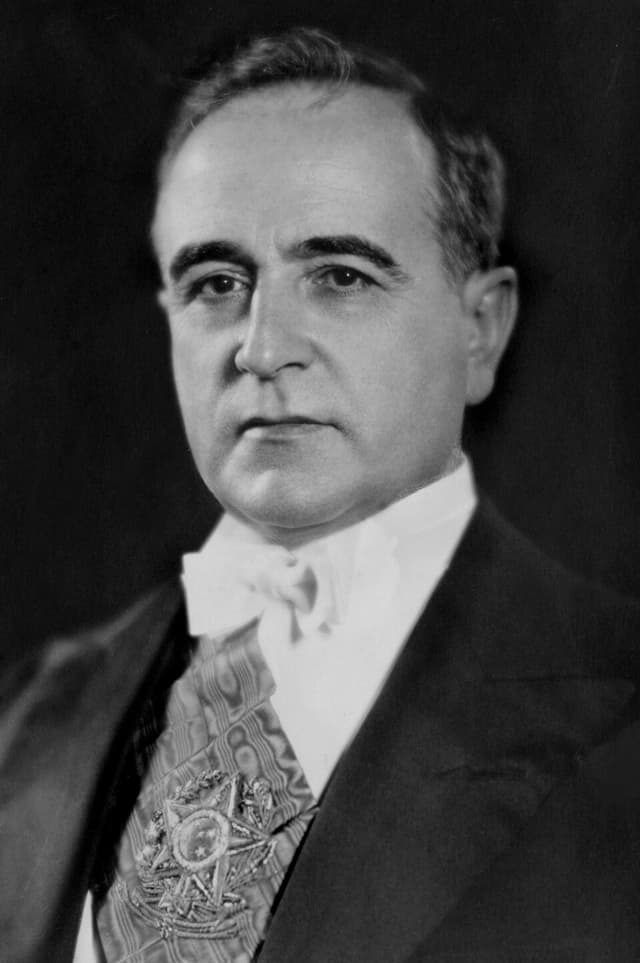
Governo do Brasil, Public domain, via Wikimedia Commons
34/100
ACE Score: 34/100
Low on the scale. An index, not a percentage.
55Medium
How total and coercive the leader’s power was.
33Low
How devoted to and dependent on the leader followers became.
15Low
How hard it was to leave.
(rule-based):Pattern: walls low enough (Bubble Score under 5) for followers to leave fairly easily. A label for these scores, not a forecast. The summary and caveats describe what actually happened.
Scores are an interpretation of published sources using the ACE scoring guide, not findings of fact. Inclusion does not classify anyone as a cult. Disclaimer
Getúlio Vargas came to power in Brazil through the 1930 revolution and was chosen president by congress in 1934. In 1937 he closed congress and declared the Estado Novo, a dictatorship with censorship and political police. He also created labour laws, a minimum wage and state industries, earning the name 'father of the poor'. The military removed him in 1945, but he won a free election in 1950 and shot himself in 1954 during a political crisis.
In academic terms, vargas's Estado Novo shows moderate to high epistemic and existential closure through censorship and political police, while his later elected term shows little; scores reflect the dictatorship peak.
Where scholars disagree
The case that the framework fits
Skidmore and Levine show a ruler who shut congress, banned parties, censored the press, tortured prisoners and handed Olga Benário, a Jewish communist, to Nazi Germany, which amounts to a clear dictatorship.
The case that it does not fit, or overstates
Levine and others also show a leader who created labour rights, won a free election in 1950, joined the Allies and left a democratic party system, a record mixing dictatorship and democracy.
The five walls
3.2 of 10
- 6
1.
Who decides what is real?
The Department of Press and Propaganda (DIP), created in 1939, censored newspapers, radio and film and ran state propaganda. Political parties were abolished in 1937.
- 1
2.
Are friends and family outside the group cut off?
No reorganisation of family life is documented.
- 2
3.
How hard is it to physically leave?
Political prisoners were held on island prisons such as Ilha Grande, but ordinary Brazilians could travel and leave.
- 2
4.
Is an apocalypse or a destined triumph always near?
The regime promised national renewal and modernisation without apocalyptic framing.
- 5
5.
Does the group decide who deserves to live?
After the 1935 communist revolt, police under Filinto Müller tortured prisoners, and Olga Benário was deported to Nazi Germany in 1936 and died there in 1942. Communists and integralists were persecuted.
Debt, dependence and harm
3 of 10, low
How much do followers feel they owe?
Workers were organised into state-controlled unions, and the work card linked rights to the corporatist system.
5 of 10, medium
How far does everything rest on one person?
Vargas built a strong federal bureaucracy, including DASP, and two parties, PSD and PTB, that dominated politics after 1945. There was no succession plan within the dictatorship.
+2, mostly outsiders
When the system turns violent, where does the harm go?
Repression targeted political opponents with torture, imprisonment and some deaths. There was no mass killing.
Methods of control
Specific techniques from the historical record that kept followers loyal and the bubble sealed.
- 01Press and propaganda department
- 02Banning of political parties
- 03Political police and torture
- 04State-controlled corporatist unions
- 05Radio programmes and national ceremonies
- 06Image as 'father of the poor'
Against the reference cases
State power, violence aimed outward
Compared with Hitler
The Estado Novo borrowed from European corporatism and repressed opponents, but Vargas sided with the Allies and ran no racial extermination programme.
A sealed group, violence aimed inward
Compared with Jones
No comparison of group control; Vargas ruled a state, not a closed community.
Through the theorists
A mix of charismatic and legal-rational authority, with a strong bureaucracy that outlasted him.
Linz
The Estado Novo fits an authoritarian rather than totalitarian regime, with limited pluralism and no guiding ideology.
Weffort
Read Vargas as the founder of Brazilian 'populism' that brought workers into politics under state tutelage.
Key sources
Strong evidence base
- Levine, Robert M. (1998). Father of the Poor? Vargas and His Era.
- Skidmore, Thomas E. (1967). Politics in Brazil, 1930–1964: An Experiment in Democracy.
Caveats
Scores are for the 1937 to 1945 Estado Novo peak, though some of the worst repression, after the 1935 revolt, came before it was declared. His 1951 to 1954 elected term would score much lower.
Cite this profile
Koziol, T. (2026). Getúlio Vargas. In ACE: Authority, Cult & Exit (Version 1.1, pilot database). Ceraluna Labs. https://cultornot.com/leader/getulio-vargas