From the ACE database. Researched and checked against published sources.
Juan Perón
1895 to 1974, rose in the 1943 military government, elected president in 1946 and 1951, overthrown in 1955, and elected again in 1973
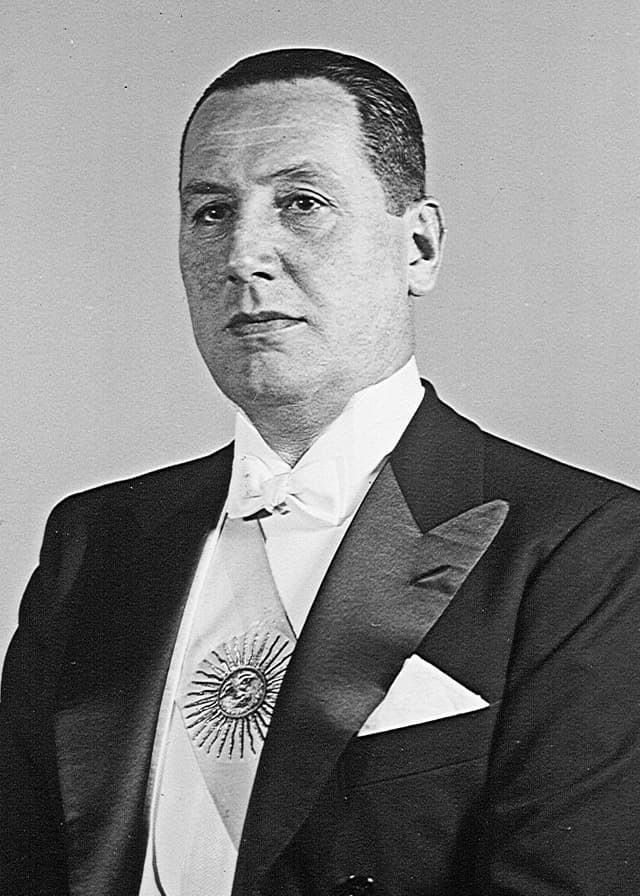
Unknown author., Public domain, via Wikimedia Commons
35/100
ACE Score: 35/100
Low on the scale. An index, not a percentage.
50Medium
How total and coercive the leader’s power was.
40Medium
How devoted to and dependent on the leader followers became.
15Low
How hard it was to leave.
(rule-based):Pattern: walls low enough (Bubble Score under 5) for followers to leave fairly easily. A label for these scores, not a forecast. The summary and caveats describe what actually happened.
Scores are an interpretation of published sources using the ACE scoring guide, not findings of fact. Inclusion does not classify anyone as a cult. Disclaimer
Juan Perón was an army officer who built a base among workers as labour minister and won the presidency in a 1946 election. With his wife Eva, he expanded workers' rights and social spending, and women gained the vote in 1947. His government impeached Supreme Court justices, took over the newspaper La Prensa, made Eva's book required reading in schools and jailed some opponents. The military overthrew him in 1955, and he returned from exile to win the 1973 election before dying in office in 1974.
In academic terms, perón combined real electoral mandates and welfare with press control and party loyalty demands; epistemic closure was notable, but spatial and existential closure stayed low to moderate, and his movement outlived him.
Where scholars disagree
The case that the framework fits
Page and others document court purges, press closures, compulsory party loyalty, torture of opponents and a personality cult around Juan and Eva Perón, which together fit an authoritarian populist model.
The case that it does not fit, or overstates
James and others stress clean election wins, women's suffrage, real gains for workers and a lasting working-class identity, and note that the deadliest political violence of his first presidency, the June 1955 bombing of the Plaza de Mayo that killed over 300 people, was carried out by his military opponents.
The five walls
3.2 of 10
- 6
1.
Who decides what is real?
A congressional committee closed dozens of opposition newspapers in 1949 and 1950, La Prensa was expropriated in 1951, and radio was brought under government allies. Eva Perón's La razón de mi vida was made mandatory in schools.
- 2
2.
Are friends and family outside the group cut off?
The regime organised youth, women and workers through Peronist bodies. Family life was not reorganised.
- 1
3.
How hard is it to physically leave?
Argentines could travel and emigrate, though some opponents went into exile to avoid arrest.
- 3
4.
Is an apocalypse or a destined triumph always near?
Perón promised a 'New Argentina' and a 'Third Position' between capitalism and communism. This was a national mission, not an apocalyptic one.
- 4
5.
Does the group decide who deserves to live?
Police tortured some political prisoners, such as labour leader Cipriano Reyes, and in 1955 Perón said five opponents would fall for every Peronist. Peronist crowds burned the Jockey Club and opposition party offices in 1953 and Catholic churches in 1955.
Debt, dependence and harm
4 of 10, medium
How much do followers feel they owe?
Public employees were pressed to join the party and contribute, unions were tied to the state through the CGT, and loyalty to the Peróns became a condition for many jobs.
5 of 10, medium
How far does everything rest on one person?
The Peronist party and CGT unions survived eighteen years of exile and bans. His succession in 1974 passed to his wife Isabel as vice president and collapsed into crisis.
+2, mostly outsiders
When the system turns violent, where does the harm go?
Repression in 1946 to 1955 was mostly arrests and torture with few deaths. In 1973 to 1974 the Triple A death squad, organised by his minister José López Rega, began killing leftists.
Methods of control
Specific techniques from the historical record that kept followers loyal and the bubble sealed.
- 01Union base tied to the state
- 02Press takeovers and closures
- 03Mandatory school texts praising the leaders
- 04Party membership pressure on public workers
- 05Mass rallies in the Plaza de Mayo
- 06Personality cult around Juan and Eva Perón
Against the reference cases
State power, violence aimed outward
Compared with Hitler
Perón admired parts of Mussolini's corporatism, but held competitive elections, had no genocidal programme and was removed by force without a war.
A sealed group, violence aimed inward
Compared with Jones
Like Jones he appealed to the poor as their protector, but there was no isolation of followers.
Through the theorists
Charismatic authority that became partly routinised in a party and union movement able to survive the leader's exile.
Germani
Read Peronism as 'national populism' that mobilised newly urban workers into politics.
Laclau
A key case of populism creating a 'people' through a leader as empty signifier.
Key sources
Strong evidence base
- Page, Joseph A. (1983). Perón: A Biography.
- James, Daniel (1988). Resistance and Integration: Peronism and the Argentine Working Class, 1946–1976.
Caveats
Scores reflect the 1946 to 1955 peak; the 1973 to 1974 term saw right-wing paramilitary violence. Argentine historiography remains politically divided.
Cite this profile
Koziol, T. (2026). Juan Perón. In ACE: Authority, Cult & Exit (Version 1.1, pilot database). Ceraluna Labs. https://cultornot.com/leader/juan-peron