From the ACE database. Researched and checked against published sources.
Jacob Frank
1726 to 1791, Frankist movement, active in Podolia, Warsaw, Częstochowa, Brno and Offenbach am Main
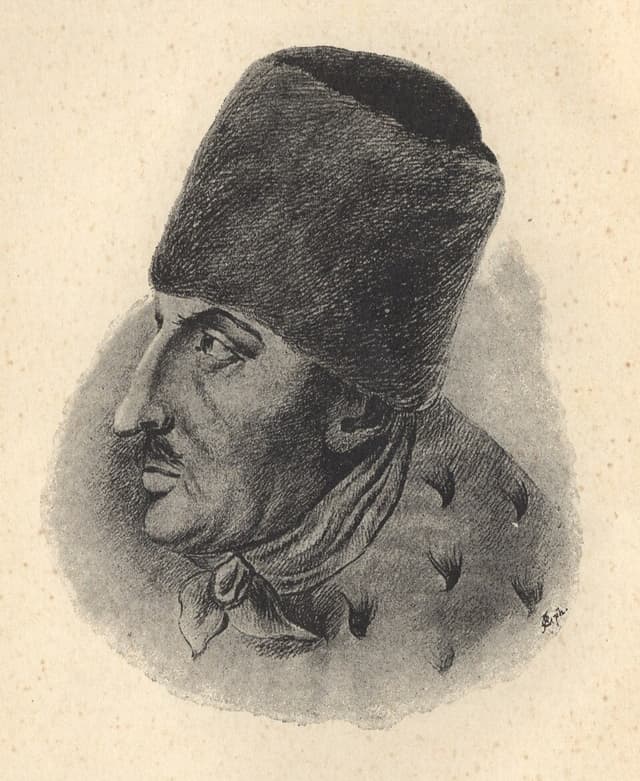
Unknown author, Public domain, via Wikimedia Commons
48/100
ACE Score: 48/100
Medium on the scale. An index, not a percentage.
40Medium
How total and coercive the leader’s power was.
60Medium
How devoted to and dependent on the leader followers became.
45Medium
How hard it was to leave.
(rule-based):Pattern: walls low enough (Bubble Score under 5) for followers to leave fairly easily. A label for these scores, not a forecast. The summary and caveats describe what actually happened.
Scores are an interpretation of published sources using the ACE scoring guide, not findings of fact. Inclusion does not classify anyone as a cult. Disclaimer
Jacob Frank was a Polish Jew who presented himself as a successor to Sabbatai Zevi. In the late 1750s he led a group of Sabbateans into public conflict with the rabbis, and in 1759 he and hundreds of followers were baptised as Catholics. The Church imprisoned him at Częstochowa from 1760 to 1772, and he later held court in Brno and Offenbach, supported by followers' money. After his death his daughter Eva led the group until it faded.
In academic terms, frank combined secret teaching, ritual transgression and financial dependence into strong debt closure inside a small circle. Spatial and existential closure stayed modest because the group had no territory and little power.
Where scholars disagree
The case that the framework fits
Frank held secret teachings, controlled members' sexual and marital lives, lived off their money and demanded loyalty that cut them off from all prior community. Scholem's essay 'Redemption Through Sin' portrays him as a nihilistic and manipulative figure.
The case that it does not fit, or overstates
Maciejko places the movement within Polish Catholic church politics and the conflict between rabbis and the Church, and warns that many accounts of sexual rites come from hostile polemics. Many converts joined Polish society and prospered, which suggests the group did not trap them.
The five walls
4.2 of 10
- 5
1.
Who decides what is real?
Frank's sayings, later collected as the Words of the Lord, were treated as authoritative and his inner teaching was kept secret from outsiders. Followers were told to maintain outward conformity while holding hidden beliefs.
- 5
2.
Are friends and family outside the group cut off?
Frank directed marriages and sexual life within the group, and accounts describe ritual sexual practices. Converts were cut off from the Jewish communities they had left.
- 4
3.
How hard is it to physically leave?
The inner circle lived at his court in Częstochowa, Brno and Offenbach and depended on it materially. People could leave, and some did, but they had broken with both Jewish and Catholic society.
- 4
4.
Is an apocalypse or a destined triumph always near?
Frank promised a coming transformation and spoke of a destined path toward redemption, but he set no fixed date.
- 3
5.
Does the group decide who deserves to live?
In the 1759 Lwów disputation the Frankists backed the accusation of ritual murder against Jews, which endangered the communities they had left. There is no record of killings by the group.
Debt, dependence and harm
7 of 10, high
How much do followers feel they owe?
Followers sent large sums to support his household, and conversion itself cost them their community, kin ties and status. Transgressive rites bound members together through shared secrets.
7 of 10, high
How far does everything rest on one person?
Frank appointed brothers and sisters to roles at court, and Eva Frank inherited leadership in 1791. Without him the group lost its finances and coherence within a generation.
+1, little harm, or balanced
When the system turns violent, where does the harm go?
The main outward harm was support for the blood libel against Jews in 1759, which could have fuelled persecution. There is little evidence of physical violence.
Methods of control
Specific techniques from the historical record that kept followers loyal and the bubble sealed.
- 01Secret inner doctrine with outward conformity
- 02Mass conversion that severed members from former communities
- 03Control over marriage and sexual life
- 04Financial support of a leader's court
- 05Shared transgressive rituals creating mutual complicity
- 06Succession through a daughter cast as a holy figure
Against the reference cases
State power, violence aimed outward
Compared with Hitler
Frank had no state power and no programme of violence; the comparison only touches his use of public accusation against Jews in 1759.
A sealed group, violence aimed inward
Compared with Jones
Like Jones, Frank built a household of dependants and used sexual control, but his followers were never isolated in a single remote site.
Through the theorists
Frank's authority remained personal and could not be routinised: Eva's succession preserved the court only briefly.
Scholem
Scholem read Frankism as the end point of Sabbatean antinomianism, where holiness was sought through breaking the law.
Coser
His court resembles a 'greedy institution' that demanded undivided loyalty and absorbed members' resources.
Key sources
Moderate evidence base
- Maciejko, Paweł (2011). The Mixed Multitude: Jacob Frank and the Frankist Movement, 1755–1816.
- Scholem, Gershom (1971). The Messianic Idea in Judaism and Other Essays on Jewish Spirituality.
Caveats
Key sources are the Words of the Lord and a Polish Chronicle, written by followers and hard to date, and polemics by rabbinic opponents such as Jacob Emden. Maciejko disputes Scholem's sharper picture. Scores reflect his court years rather than his early Podolian activity.
Cite this profile
Koziol, T. (2026). Jacob Frank. In ACE: Authority, Cult & Exit (Version 1.1, pilot database). Ceraluna Labs. https://cultornot.com/leader/jacob-frank