From the ACE database. Researched and checked against published sources.
Josip Broz Tito
1892 to 1980, Partisan leader in the Second World War and ruler of socialist Yugoslavia until his death
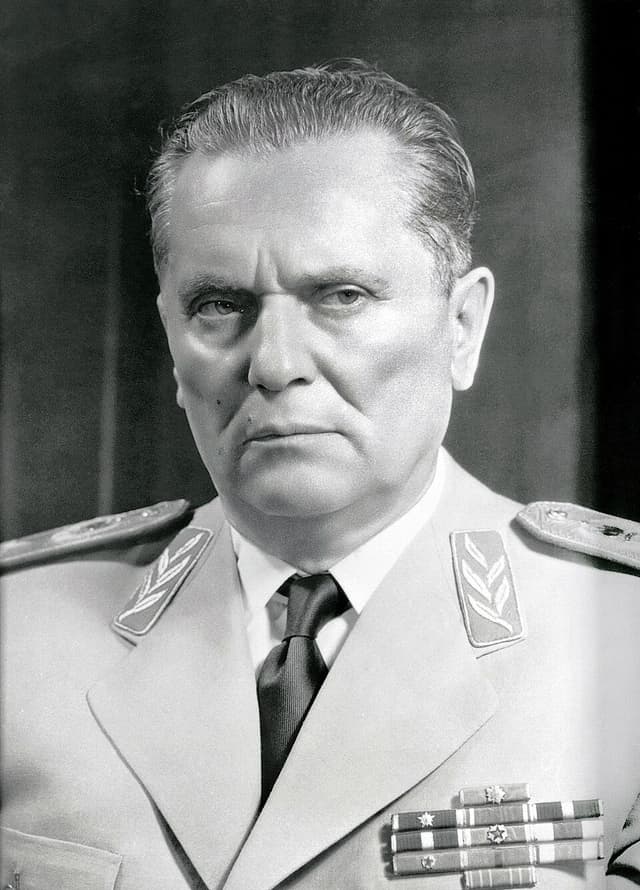
Unknown author, Public domain, via Wikimedia Commons
49/100
ACE Score: 49/100
Medium on the scale. An index, not a percentage.
65Medium
How total and coercive the leader’s power was.
47Medium
How devoted to and dependent on the leader followers became.
35Low
How hard it was to leave.
(rule-based):Pattern: walls low enough (Bubble Score under 5) for followers to leave fairly easily. A label for these scores, not a forecast. The summary and caveats describe what actually happened.
Scores are an interpretation of published sources using the ACE scoring guide, not findings of fact. Inclusion does not classify anyone as a cult. Disclaimer
Josip Broz Tito led the communist Partisans against Axis occupation and took power in Yugoslavia in 1945. His forces killed tens of thousands of defeated enemy soldiers and civilians at the end of the war. After breaking with Stalin in 1948 he jailed suspected pro-Soviet communists, many on the island camp of Goli Otok. From the 1960s Yugoslavia became one of the most open communist states, letting citizens travel and work abroad. Tito was celebrated with a large personality cult and was made president for life.
In academic terms, tito's case shows closure that was high in the late 1940s and fell sharply later, held together by a hero cult; the system's dependence on him became clear when the collective presidency failed after his death.
Where scholars disagree
The case that the framework fits
Historians such as Jože Pirjevec document mass killings in 1945, the brutal Goli Otok camp, and a lavish personality cult built around Tito's person.
The case that it does not fit, or overstates
Many scholars and former Yugoslavs credit Tito with defeating fascism, holding a multi-ethnic state together, resisting Stalin and allowing far more freedom than other communist states. They see his later rule as a soft authoritarianism that does not fit cult models.
The five walls
4.8 of 10
- 6
1.
Who decides what is real?
The party controlled the press and criticism of Tito was punishable, as Milovan Đilas found when he was jailed for his writings. Yet Western media, travel and a lively cultural life were available from the 1960s onward.
- 3
2.
Are friends and family outside the group cut off?
The state did not try to break up families, and ordinary social life was left largely alone. During the 1948 to 1956 Cominform purge, people were pressured to denounce colleagues and friends.
- 4
3.
How hard is it to physically leave?
Borders were tightly closed in the late 1940s, but from the 1960s Yugoslavs could hold passports and hundreds of thousands worked in Western Europe. Political prisoners were held on the island camp of Goli Otok, where about 16,000 people served time.
- 4
4.
Is an apocalypse or a destined triumph always near?
Official ideology promised a socialist future through workers' self-management and the brotherhood and unity of Yugoslav peoples. This was a long-horizon goal rather than an imminent end.
- 7
5.
Does the group decide who deserves to live?
In May and June 1945 Partisan forces killed tens of thousands of Croatian, Slovene, Serbian and Montenegrin collaborationist soldiers and civilians after the Bleiburg repatriations; no reliable count exists. About 400 to 600 deaths on Goli Otok are documented, while some survivor-based claims reach about 4,000.
Debt, dependence and harm
5 of 10, medium
How much do followers feel they owe?
Party membership was needed for most careers, and prisoners on Goli Otok were forced to beat and inform on fellow inmates to prove their reform. Ordinary citizens faced fewer demands as the system liberalised.
5 of 10, medium
How far does everything rest on one person?
Yugoslavia had a large party and federal state, and the 1974 constitution created a rotating collective presidency to follow Tito. In practice Tito was the final arbiter, and the federation unravelled within a decade of his death.
+6, mostly outsiders
When the system turns violent, where does the harm go?
Outward: the great majority of deaths fell on groups the regime defined as enemies, namely defeated collaborationist forces and civilians in 1945, ethnic German civilians held in camps from 1944 to 1948, and non-communist opponents. Inward: the 1948 to 1956 Goli Otok purge targeted fellow communists accused of siding with Stalin, with hundreds to a few thousand deaths.
Methods of control
Specific techniques from the historical record that kept followers loyal and the bubble sealed.
- 01Wartime hero cult with Tito's birthday celebrated as Youth Day relay
- 02Single-party control of press, courts and security police (UDBA)
- 03Re-education camps such as Goli Otok with forced self-criticism and inmate violence
- 04Reprisal killings of defeated enemies in 1945
- 05Patronage through party membership and enterprise posts
- 06Opening borders to labour migration as a safety valve
Against the reference cases
State power, violence aimed outward
Compared with Hitler
Unlike Hitler, Tito built a state on multi-ethnic unity rather than racial exclusion, though he shared a hero cult and used mass reprisals against enemies.
A sealed group, violence aimed inward
Compared with Jones
Tito's later Yugoslavia let people leave freely for work abroad, the opposite of Jones's sealed settlement.
Through the theorists
Tito held classic charismatic authority earned in war, and the 1974 constitution was an attempt to routinise it that did not survive him.
Albert Hirschman
Allowing exit through labour migration reduced pressure for voice, which helped the regime stay stable without heavy repression.
Hannah Arendt
Yugoslavia after 1948 lacked the permanent terror and ideological totalism Arendt saw as defining totalitarianism, which places Tito outside her strict category.
Key sources
Moderate evidence base
- Pirjevec, Jože (2018). Tito and His Comrades.
- Swain, Geoffrey (2011). Tito: A Biography.
Caveats
Scores average a harsh early period (1945 to 1956) and a much milder later period; peak values would be higher for spatial and epistemic closure. Numbers killed in 1945 are politically charged in the former Yugoslav states and estimates vary widely. Communist-era sources glorified Tito, and some post-1990 nationalist sources exaggerate his crimes. Under the regime rule, the 1945 killings count as outward and the Goli Otok purge of party members as inward; the net is clearly outward.
Cite this profile
Koziol, T. (2026). Josip Broz Tito. In ACE: Authority, Cult & Exit (Version 1.1, pilot database). Ceraluna Labs. https://cultornot.com/leader/josip-broz-tito