From the ACE database. Researched and checked against published sources.
Joseph Di Mambro
1924 to 1994, co-founder and real leader of the Order of the Solar Temple, with Luc Jouret as its public face
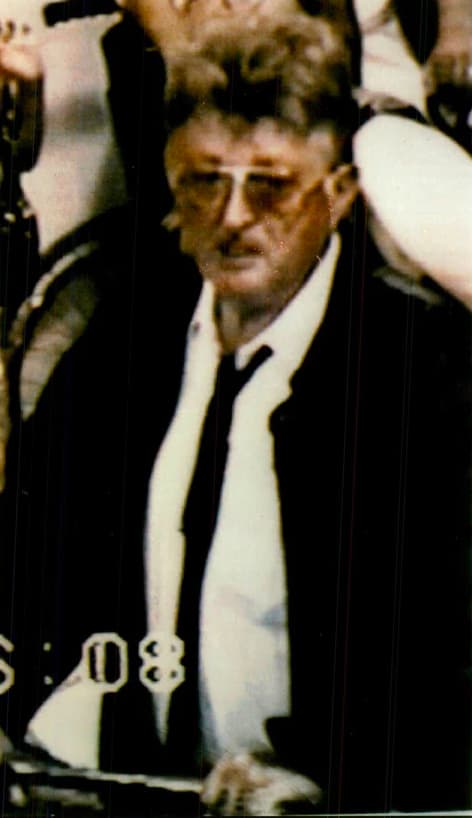
Brisbane airport surveillance camera, Public domain, via Wikimedia Commons
71/100
ACE Score: 71/100
High on the scale. An index, not a percentage.
85High
How total and coercive the leader’s power was.
77High
How devoted to and dependent on the leader followers became.
50Medium
How hard it was to leave.
(rule-based):Pattern: a closed system with little institutional restraint, where harm was aimed mainly at its own people. A label for these scores, not a forecast. The summary and caveats describe what actually happened.
Scores are an interpretation of published sources using the ACE scoring guide, not findings of fact. Inclusion does not classify anyone as a cult. Disclaimer
Joseph Di Mambro founded the Order of the Solar Temple in 1984 with Luc Jouret, a homeopathic doctor who recruited through lectures. The order mixed neo-Templar ritual, New Age ideas and apocalyptic fears and drew many wealthy, educated members in Switzerland, France and Quebec. Di Mambro controlled the group's money and rituals and arranged members' couples, while special effects were secretly staged in ceremonies. In October 1994, 53 people died in Quebec and Switzerland, including Di Mambro and Jouret; Swiss investigators found that many were murdered. Later 'transits' in France in 1995 and Quebec in 1997 brought the total to 74.
In academic terms, the Solar Temple shows that mass death can arise with low spatial closure: members lived ordinary lives, but esoteric secrecy, high temporal closure and a doctrine of 'transit' to another world let a failing leader draw them into murder and suicide.
Where scholars disagree
The case that the framework fits
Mayer and Introvigne describe a closed esoteric hierarchy in which the leaders' doctrine of transit justified both suicide and the killing of those seen as traitors.
The case that it does not fit, or overstates
Scholars note that most members lived free lives and joined a respectable-seeming esoteric order. Hall and Schuyler argue that the end came from Di Mambro's illness, money troubles, fear of exposure and the 1993 Jouret gun scandal more than from long-term planning, and they doubt the police account that the Dutoit baby was seen as the antichrist, suggesting revenge for Tony Dutoit's betrayal instead.
The five walls
7.2 of 10
- 7
1.
Who decides what is real?
Teachings were secret and graded, and ceremonies used staged effects presented as appearances of spiritual masters. Tony Dutoit, who had distanced himself from the group and threatened to expose the fakes, was killed with his wife and baby son in Quebec in 1994.
- 6
2.
Are friends and family outside the group cut off?
Di Mambro assigned 'cosmic couples' and decided on members' relationships and children. His daughter Emmanuelle was raised as a 'cosmic child' within the group.
- 4
3.
How hard is it to physically leave?
Most members kept homes and jobs and some lived in group houses. Leaving was possible, and many members drifted away in the early 1990s.
- 9
4.
Is an apocalypse or a destined triumph always near?
From around 1990 Di Mambro and Jouret taught that the world faced catastrophe and that members would 'transit' to the star Sirius. The deaths were prepared with written testaments and timed fires.
- 10
5.
Does the group decide who deserves to live?
Fifty-three people died in October 1994; a Swiss magistrate found only 15 of these were clearly voluntary suicides. The Dutoit infant was stabbed to death on Di Mambro's orders, and 'traitors' were killed.
Debt, dependence and harm
7 of 10, high
How much do followers feel they owe?
Wealthy members gave large sums to the order, and some victims were reportedly lured to the final gatherings with promises that their money would be returned. Members' family arrangements were also handed to the leadership.
7 of 10, high
How far does everything rest on one person?
The order had grades, lodges and a secret inner circle, and authority was shared on paper with Jouret. In practice Di Mambro controlled money, ritual and doctrine.
-10, mostly insiders
When the system turns violent, where does the harm go?
All 74 victims across 1994 to 1997 were members or their children. No outsiders were targeted.
Methods of control
Specific techniques from the historical record that kept followers loyal and the bubble sealed.
- 01Graded secret initiations
- 02Staged ritual apparitions
- 03Leader-assigned 'cosmic couples'
- 04Large financial donations
- 05Doctrine of 'transit' to Sirius
- 06Labelling defectors as traitors
Against the reference cases
State power, violence aimed outward
Compared with Hitler
Unlike Hitler, Di Mambro aimed no violence at outsiders and had no political base; his order destroyed itself.
A sealed group, violence aimed inward
Compared with Jones
Like Jones, Di Mambro led an inward mass death framed as a meaningful departure, but his members were not held in an isolated settlement.
Through the theorists
Di Mambro's authority mixed charisma with the trappings of an ancient order, but it was never separable from his person.
Wessinger
The Solar Temple fits Wessinger's 'fragile' millennial group: internal decay and outside scrutiny led the leaders to choose a violent exit.
Introvigne
Introvigne places the order in the history of neo-Templar esotericism, showing how secret-society forms let a small inner circle control a wider membership.
Key sources
Moderate evidence base
- Mayer, Jean-François (1999). 'Our Terrestrial Journey Is Coming to an End': The Last Voyage of the Solar Temple.
- Introvigne, Massimo (1995). Ordeal by Fire: The Tragedy of the Solar Temple.
- Hall, John R., with Philip D. Schuyler and Sylvaine Trinh (2000). Apocalypse Observed: Religious Movements and Violence in North America, Europe, and Japan.
- Lewis, James R. (ed.) (2006). The Order of the Solar Temple: The Temple of Death.
Caveats
Di Mambro and Jouret shared leadership and their roles are hard to separate; most scholars see Di Mambro as the real power. Later deaths in 1995 and 1997 happened after both leaders died. Some theories of outside involvement circulated but are not supported by scholarly accounts.
Cite this profile
Koziol, T. (2026). Joseph Di Mambro. In ACE: Authority, Cult & Exit (Version 1.1, pilot database). Ceraluna Labs. https://cultornot.com/leader/joseph-di-mambro