From the ACE database. Researched and checked against published sources.
Donald DeFreeze
1943 to 1974, escaped from prison in March 1973, led the Symbionese Liberation Army as 'General Field Marshal Cinque' until his death in Los Angeles in May 1974
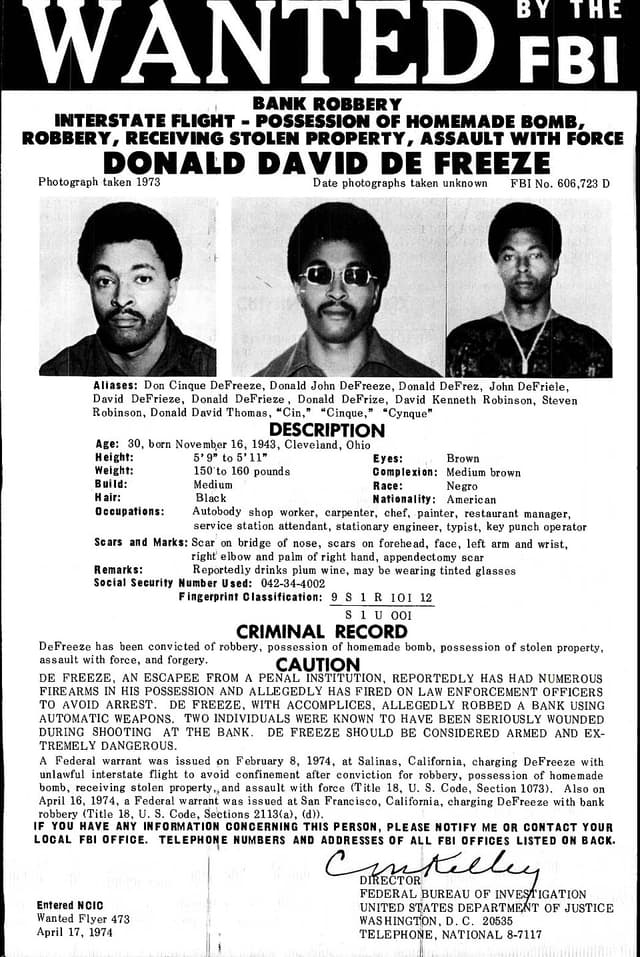
FBI, Public domain, via Wikimedia Commons
71/100
ACE Score: 71/100
High on the scale. An index, not a percentage.
70High
How total and coercive the leader’s power was.
73High
How devoted to and dependent on the leader followers became.
70High
How hard it was to leave.
(rule-based):Pattern: a closed system with little institutional restraint, where harm was aimed mainly at outsiders. A label for these scores, not a forecast. The summary and caveats describe what actually happened.
Scores are an interpretation of published sources using the ACE scoring guide, not findings of fact. Inclusion does not classify anyone as a cult. Disclaimer
Donald DeFreeze escaped from Soledad prison in 1973 and became leader of the Symbionese Liberation Army, a small armed group of mostly white middle-class radicals in the San Francisco Bay Area. In November 1973 the group murdered Oakland school superintendent Marcus Foster. In February 1974 it kidnapped newspaper heiress Patricia Hearst, kept her blindfolded in a closet for weeks, and she later joined the group in a bank robbery. DeFreeze and five other members died on 17 May 1974 in a shootout and fire with Los Angeles police.
In academic terms, deFreeze led a group of about a dozen that sealed itself off in safe houses, producing high closure on every axis but short life and almost no routinization. Its violence was aimed outward, though its own members died in a police shootout.
Where scholars disagree
The case that the framework fits
Toobin and McLellan and Avery describe a tiny group in safe houses with a commanding leader, ritual titles and a captive who was resocialised into the group, which fits a high-control cell.
The case that it does not fit, or overstates
Toobin argues that Hearst chose to join to a greater extent than her defence claimed, which complicates a pure brainwashing account. The group lasted barely a year, so it is better seen as a political terror cell than a long-term cult.
The five walls
7 of 10
- 7
1.
Who decides what is real?
The group lived in safe houses under constant political instruction, and Hearst described weeks of indoctrination while confined. Communiqués presented DeFreeze's statements as revolutionary law.
- 7
2.
Are friends and family outside the group cut off?
Members cut ties with families and took new names, and Hearst's family was cast as part of the 'fascist' enemy. Sexual relations inside the group were treated as a collective matter.
- 7
3.
How hard is it to physically leave?
Members lived armed and underground, and Hearst was held captive in a closet. Leaving meant facing police and the group's own suspicion.
- 7
4.
Is an apocalypse or a destined triumph always near?
The SLA declared war on the 'fascist insect that preys upon the life of the people' and expected a coming revolutionary war. Members wrote wills and expected to die in battle.
- 7
5.
Does the group decide who deserves to live?
The group shot Marcus Foster with cyanide-tipped bullets in 1973 and announced death sentences on enemies. After DeFreeze's death, remaining members killed Myrna Opsahl in a 1975 bank robbery.
Debt, dependence and harm
7 of 10, high
How much do followers feel they owe?
Members gave up careers, families and legal identities and committed crimes that made return to normal life very hard. The group's 'codes of war' demanded total obedience.
8 of 10, high
How far does everything rest on one person?
DeFreeze held the title of field marshal and there were assigned ranks, but no structure beyond him. After May 1974 a few survivors carried on briefly before arrests.
+5, mostly outsiders
When the system turns violent, where does the harm go?
The SLA's violence under DeFreeze was aimed at outsiders: the political killing of Marcus Foster, the wounding of his deputy Robert Blackburn, the kidnapping of Hearst and armed robbery. The six members who died in May 1974 were killed by police, which the rubric does not count as violence by the movement.
Methods of control
Specific techniques from the historical record that kept followers loyal and the bubble sealed.
- 01Life in armed safe houses
- 02Constant political instruction
- 03Assigned revolutionary names and ranks
- 04Captivity and resocialisation of a hostage
- 05'Codes of war' demanding total obedience
- 06Shared complicity in murder and robbery
Against the reference cases
State power, violence aimed outward
Compared with Hitler
Beyond a language of enemies as 'insects', there is little in common: the SLA had about a dozen members and no wider movement.
A sealed group, violence aimed inward
Compared with Jones
Both groups ended in mass death in a closed space, but the SLA's members died in a police shootout, not by their own leader's order.
Through the theorists
Unroutinised charismatic authority in its purest small form, which ended with the leader's death.
Hearst's captivity shows milieu control and demand for purity applied to a single unwilling recruit.
Toobin
Toobin reads the SLA as a product of 1970s radical culture and media spectacle, not only of DeFreeze's personality.
Key sources
Moderate evidence base
- Toobin, Jeffrey (2016). American Heiress: The Wild Saga of the Kidnapping, Crimes and Trial of Patty Hearst.
- McLellan, Vin, and Paul Avery (1977). The Voices of Guns.
Caveats
The vector excludes the deaths of DeFreeze and five others in the May 1974 Los Angeles shootout and fire, because police, not the group, caused them; the SLA did fire heavily on police during it. Accounts conflict, especially about Hearst's free will, which was the core issue at her trial. Evidence about internal life comes partly from Hearst and from members later prosecuted. The group was too short-lived to show change over time.
Cite this profile
Koziol, T. (2026). Donald DeFreeze. In ACE: Authority, Cult & Exit (Version 1.1, pilot database). Ceraluna Labs. https://cultornot.com/leader/donald-defreeze