From the ACE database. Researched and checked against published sources.
Kim Il-sung
1912 to 1994, installed with Soviet backing in 1945 and leader of the Democratic People's Republic of Korea from 1948 until his death in July 1994
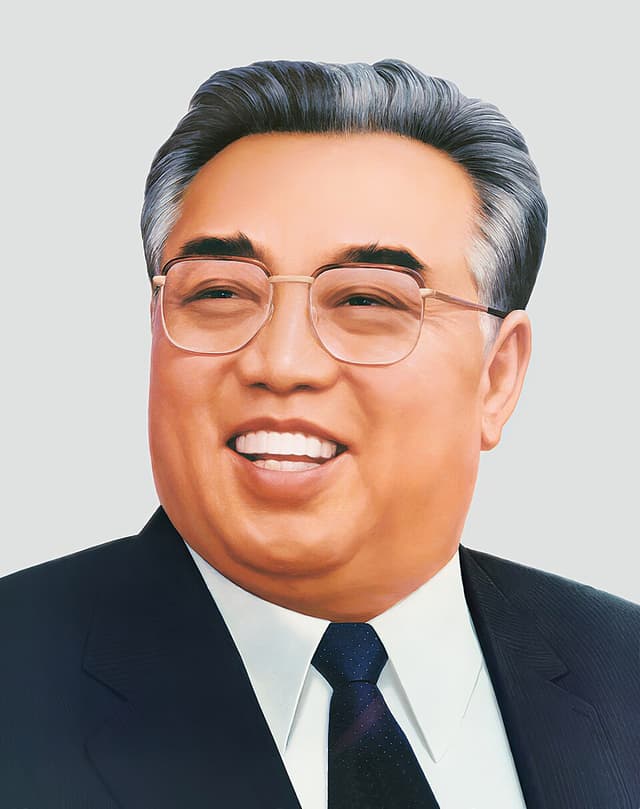
Jesse Charlie, CC0, via Wikimedia Commons
87/100
ACE Score: 87/100
High on the scale. An index, not a percentage.
95High
How total and coercive the leader’s power was.
70High
How devoted to and dependent on the leader followers became.
95High
How hard it was to leave.
:Systems like this tend to be brought down from outside once their violence meets a stronger force.
Scores are an interpretation of published sources using the ACE scoring guide, not findings of fact. Inclusion does not classify anyone as a cult. Disclaimer
Kim Il-sung was a former anti-Japanese guerrilla whom Soviet forces placed in power in northern Korea in 1945. In 1950 he invaded the South, starting the Korean War, in which millions died. Over the following decades he purged rivals, built a vast personality cult and sorted the whole population by political loyalty, a system called songbun. He arranged for his son Kim Jong-il to succeed him, creating the world's first communist dynasty.
In academic terms, kim Il-sung built the most durable sealed state of the twentieth century, with near-total closure on every axis and a cult that solved the succession problem by turning charisma into family inheritance.
Where scholars disagree
The case that the framework fits
Kwon and Chung describe North Korea as a 'theatre state' built around the charismatic family, and Suh traces how Kim systematically built his own legend. The ritual devotion and self-criticism sessions closely match high-control group practice.
The case that it does not fit, or overstates
Lankov shows Kim began as a Soviet appointee rather than a self-made prophet, and Myers argues the real ideology is racial nationalism rather than devotion to a leader alone. Many citizens comply out of fear and need rather than belief.
The five walls
8.8 of 10
- 10
1.
Who decides what is real?
Radios were sold with fixed tuning to state channels, and all media, schooling and art glorified Kim and his family. Listening to foreign broadcasts or criticising the leader could send a person and their family to a prison camp.
- 9
2.
Are friends and family outside the group cut off?
The songbun system classed every family by its ancestors' loyalty, which shaped schooling, jobs and marriage. Political crimes were punished by sending up to three generations of a family to camps.
- 10
3.
How hard is it to physically leave?
Citizens needed permits to travel even between provinces, and leaving the country was forbidden. The border was guarded and political prison camps held tens of thousands of people, by some estimates over 100,000.
- 6
4.
Is an apocalypse or a destined triumph always near?
The regime taught that Korea's reunification under Kim's leadership was historically destined, and that an American attack could come at any time. Permanent war mobilisation shaped daily life, though without a dated end.
- 9
5.
Does the group decide who deserves to live?
Purges such as the crushing of the 'August faction' after 1956 removed rivals, and camps with high death rates held those labelled hostile. The 1950 invasion of the South led to a war that killed millions.
Debt, dependence and harm
9 of 10, high
How much do followers feel they owe?
The state controlled food through the public distribution system, as well as housing and jobs. Weekly 'life review' sessions required citizens to criticise themselves and each other in front of their work unit.
6 of 10, medium
How far does everything rest on one person?
The Workers' Party and army were large organisations, but power flowed from Kim personally. He created a recognised succession by naming his son, whose role became public at the 1980 party congress, but the mechanism was dynastic rather than procedural.
+7, mostly outsiders
When the system turns violent, where does the harm go?
Outward: the June 1950 invasion of South Korea, a war of aggression in which millions died, and the camps and executions for families labelled 'hostile'. Inward: purges of the party's southern, Yan'an and Soviet factions in the 1950s, which removed or killed many senior cadres but on a far smaller scale.
Methods of control
Specific techniques from the historical record that kept followers loyal and the bubble sealed.
- 01Personality cult in every home and workplace
- 02Songbun loyalty classification of families
- 03Collective punishment across three generations
- 04Weekly self-criticism sessions
- 05Fixed-tuned radios and sealed media
- 06Travel permits and sealed borders
- 07State control of food rations
Against the reference cases
State power, violence aimed outward
Compared with Hitler
Both leaders started aggressive wars, but Kim's system lasted far longer and passed power to his son, which Hitler never attempted.
A sealed group, violence aimed inward
Compared with Jones
North Korea, like Jonestown, cut its people off from outside information and made survival depend on the leader, but at the scale of a state lasting decades.
Through the theorists
Kim solved the classic problem of routinising charisma by making it hereditary, a 'charisma of lineage'.
Atomised citizens watched by informers and neighbourhood groups fit Arendt's picture of total domination.
Kwon and Chung
The state works as a theatre of devotion in which the partisan myth of the leader is performed in everyday life.
Key sources
Moderate evidence base
- Suh, Dae-Sook (1988). Kim Il Sung: The North Korean Leader.
- Lankov, Andrei (2002). From Stalin to Kim Il Sung: The Formation of North Korea, 1945–1960.
- Myers, B. R. (2010). The Cleanest Race: How North Koreans See Themselves and Why It Matters.
Caveats
Evidence comes from defectors, Soviet archives and state media, each with biases. Control and the cult grew steadily from the 1950s to their peak in the 1970s and 1980s. Death tolls in the camps are estimates. On the vector, the Korean War and the persecution of 'hostile' classes in camps count as outward; the purges of rival party factions count as inward and were much smaller. Many Korean War deaths were caused by UN and South Korean forces, but the war began with the North's invasion.
Cite this profile
Koziol, T. (2026). Kim Il-sung. In ACE: Authority, Cult & Exit (Version 1.1, pilot database). Ceraluna Labs. https://cultornot.com/leader/kim-il-sung