From the ACE database. Researched and checked against published sources.
Kim Jong-il
1941 to 2011, designated successor from the 1970s and leader of North Korea from his father's death in 1994 until his own death in December 2011
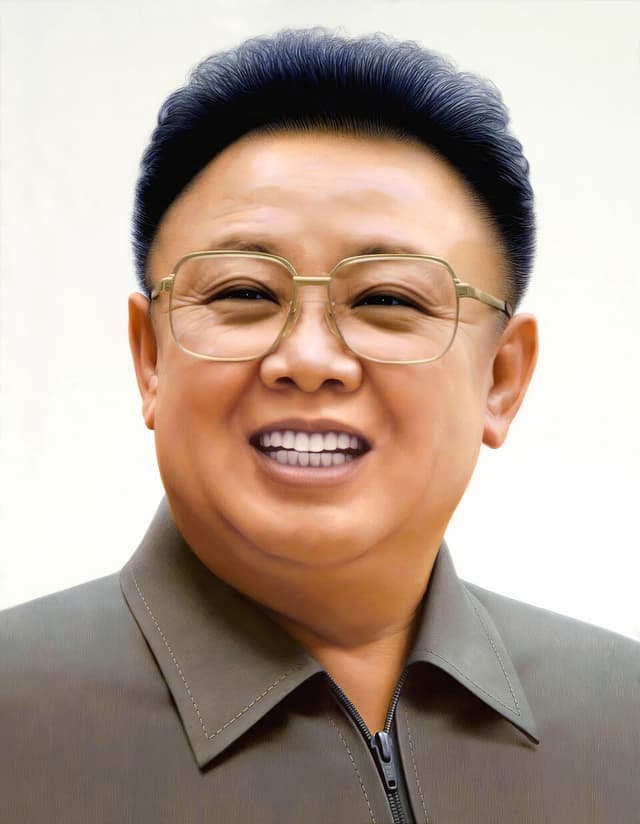
Jesse Charlie, CC0, via Wikimedia Commons
87/100
ACE Score: 87/100
High on the scale. An index, not a percentage.
95High
How total and coercive the leader’s power was.
70High
How devoted to and dependent on the leader followers became.
95High
How hard it was to leave.
:Systems like this tend to destroy themselves, because nobody inside can stop the leader.
Scores are an interpretation of published sources using the ACE scoring guide, not findings of fact. Inclusion does not classify anyone as a cult. Disclaimer
Kim Jong-il took over North Korea when his father died in 1994. In his first years a famine, known locally as the 'Arduous March', killed somewhere between 600,000 and one million people. He put the army first ('songun'), developed nuclear weapons, and kept the political prison camps and the family cult running. Official myth claimed he was born on Mount Paektu, though historians place his birth in the Soviet Union.
In academic terms, kim Jong-il inherited near-total closure and kept it intact through famine, showing that a sealed system can survive mass death among its own people when debt and spatial closure are absolute.
Where scholars disagree
The case that the framework fits
Demick's interviews show how deeply many citizens grieved and believed, and Kwon and Chung argue the regime ran on staged devotion to the leader family. This fits the model of a sealed high-demand group.
The case that it does not fit, or overstates
Haggard and Noland show the famine grew from economic collapse and policy failure, not from intent to kill. Growing private markets in the late 1990s meant many people relied less on the state, which weakened the dependence model.
The five walls
8.8 of 10
- 10
1.
Who decides what is real?
State media monopolised information and the leader cult extended to Kim Jong-il's own invented biography. Possessing foreign films or radios was punished, sometimes by execution.
- 9
2.
Are friends and family outside the group cut off?
The songbun system and three-generation punishment continued. Neighbourhood watch units (inminban) monitored households and reported on family members.
- 10
3.
How hard is it to physically leave?
Internal travel required permits and leaving the country without permission was a serious crime. Many who fled to China during the famine were sent back and imprisoned.
- 6
4.
Is an apocalypse or a destined triumph always near?
The regime framed the country as permanently threatened by the United States and placed the army above all other needs. Hardship was presented as a heroic march to victory, not as a coming end.
- 9
5.
Does the group decide who deserves to live?
A 2014 UN Commission of Inquiry found crimes against humanity, including executions, torture and starvation in camps that held an estimated 80,000 to 120,000 people. Public executions were used to deter dissent.
Debt, dependence and harm
9 of 10, high
How much do followers feel they owe?
When the public distribution system collapsed, survival still depended on loyalty and on permission to trade. Self-criticism sessions and compulsory labour mobilisation continued throughout.
6 of 10, medium
How far does everything rest on one person?
Kim ruled through the army's National Defence Commission rather than through regular party bodies. He named his young son Kim Jong-un as heir only around 2010, continuing a dynastic rather than procedural succession.
-3, mostly insiders
When the system turns violent, where does the harm go?
Inward: the famine of the mid-1990s killed roughly 600,000 to one million ordinary citizens the regime claimed as its own. Outward: deaths in camps and executions of people labelled hostile, the abduction of Japanese citizens admitted in 2002, and the 2010 sinking of the South Korean warship Cheonan, which an international investigation blamed on North Korea; these were serious but smaller in scale.
Methods of control
Specific techniques from the historical record that kept followers loyal and the bubble sealed.
- 01Inherited leader cult with invented biography
- 02Military-first rule
- 03Neighbourhood watch units
- 04Political prison camps and public executions
- 05Punishment of returned defectors
- 06Control of food during famine
- 07Ban on foreign media
Against the reference cases
State power, violence aimed outward
Compared with Hitler
Unlike Hitler, Kim Jong-il fought no major war, and his regime's worst harm fell on its own population.
A sealed group, violence aimed inward
Compared with Jones
Like Jones, Kim presided over mass death among his own people while demanding devotion, though the famine came from failure and neglect rather than an organised act.
Through the theorists
Kim Jong-il shows routinised, hereditary charisma that needed constant ritual to keep its claim alive.
Wintrobe
Ronald Wintrobe's model of dictators trading repression against loyalty helps explain why the regime spent scarce resources on the army and elite during the famine.
Kwon and Chung
His rule moved the partisan state toward a 'military-first' form while keeping the theatre of devotion.
Key sources
Moderate evidence base
- Haggard, Stephan, and Marcus Noland (2007). Famine in North Korea: Markets, Aid, and Reform.
- Demick, Barbara (2009). Nothing to Envy: Ordinary Lives in North Korea.
- Kwon, Heonik, and Byung-Ho Chung (2012). North Korea: Beyond Charismatic Politics.
Caveats
Famine death estimates range from about 600,000 to over two million in some claims; Haggard and Noland estimate 600,000 to one million. Most evidence on camps comes from defectors. On the vector, famine deaths count as inward, while camp deaths, executions of people labelled hostile, and attacks on Japanese and South Koreans count as outward. Camp deaths are poorly documented, so the true net could be closer to zero, and much of the inward harm came through neglect rather than direct violence.
Cite this profile
Koziol, T. (2026). Kim Jong-il. In ACE: Authority, Cult & Exit (Version 1.1, pilot database). Ceraluna Labs. https://cultornot.com/leader/kim-jong-il