From the ACE database. Researched and checked against published sources.
L. Ron Hubbard
1911 to 1986, founder of Dianetics in 1950 and the Church of Scientology in 1954; led the Sea Organization from 1967
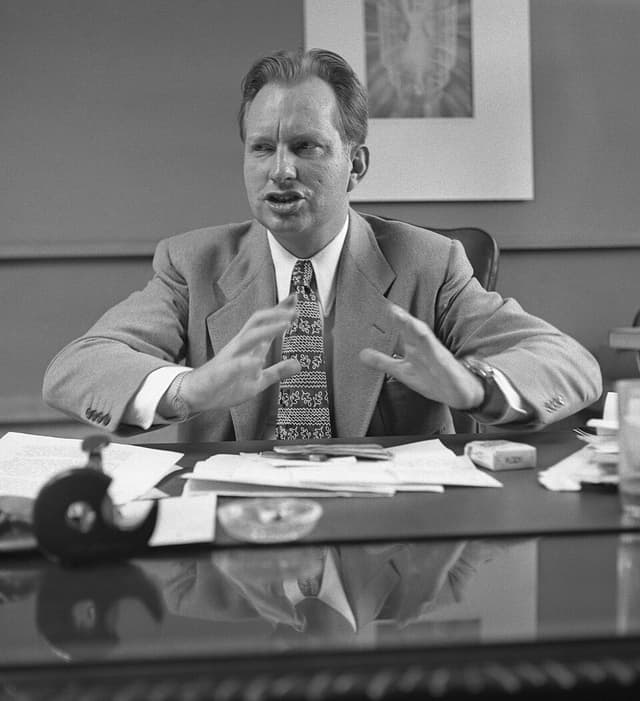
Adam Cuerden, CC BY 4.0, via Wikimedia Commons
58/100
ACE Score: 58/100
Medium on the scale. An index, not a percentage.
60Medium
How total and coercive the leader’s power was.
50Medium
How devoted to and dependent on the leader followers became.
65Medium
How hard it was to leave.
(rule-based):Pattern: a closed system with strong offices, rules and succession. A label for these scores, not a forecast. The summary and caveats describe what actually happened.
Scores are an interpretation of published sources using the ACE scoring guide, not findings of fact. Inclusion does not classify anyone as a cult. Disclaimer
L. Ron Hubbard, a science fiction writer, published Dianetics in 1950 and turned it into the Church of Scientology in 1954. Members pay for graded courses and 'auditing' sessions to rise through levels of spiritual freedom. From 1967 he ran the movement from ships staffed by the Sea Organization, whose members signed billion-year contracts. His policies labelled critics 'suppressive persons', and church agents carried out harassment and the Operation Snow White infiltration of US government offices, for which his wife and others were convicted.
In academic terms, hubbard built high epistemic and social closure for core staff through ethics technology, disconnection and confidential auditing records, and directed hostility outward through Fair Game. Wallis reads this as a cultic milieu hardened into a totalitarian sect, while routinised policy letters let the system outlive him.
Where scholars disagree
The case that the framework fits
Wallis, Miller and many ex-members describe Fair Game, disconnection, the Rehabilitation Project Force and the use of auditing confessions as features of a high-control system. US court cases and the Snow White convictions document organised hostility to outsiders.
The case that it does not fit, or overstates
Melton and other scholars of religion treat Scientology as a genuine religion and stress that most Scientologists are paying lay members who live ordinary lives; the church won US tax exemption as a religion in 1993. Urban, though critical of its secrecy, reads much of its conduct as a response to long legal battles over its status, and some scholars caution that ex-member testimony from litigation may overstate abuse.
The five walls
5.8 of 10
- 7
1.
Who decides what is real?
Hubbard's writings were declared the only workable 'Tech', and 'Keeping Scientology Working' forbade altering them. Critical material was classed as 'entheta', and staff who voiced doubts could be sent to ethics handling.
- 7
2.
Are friends and family outside the group cut off?
Members connected to people declared 'suppressive persons' were told to disconnect or face penalties. Sea Org members' children were often cared for in group nurseries away from their parents.
- 6
3.
How hard is it to physically leave?
Sea Org staff lived aboard ships from 1967 to 1975 and later in church housing, with low pay and travel controlled by the organisation. Members assigned to the Rehabilitation Project Force from 1974 did hard labour under supervision. Ordinary public Scientologists lived at home.
- 4
4.
Is an apocalypse or a destined triumph always near?
Hubbard framed the mission as clearing the planet before civilisation destroyed itself, and his upper-level cosmology placed humanity in a vast galactic history. There is no dated end.
- 5
5.
Does the group decide who deserves to live?
Policy described suppressive persons as enemies who 'may be tricked, sued or lied to or destroyed' under the Fair Game policy, and church agents harassed critics such as Paulette Cooper. No killings of critics are documented.
Debt, dependence and harm
7 of 10, high
How much do followers feel they owe?
Advanced courses and auditing cost very large sums, and Sea Org staff surrendered careers on billion-year contracts. Confidential auditing records held intimate confessions, which ex-members say were used as leverage.
4 of 10, medium
How far does everything rest on one person?
Hubbard issued thousands of policy letters and built a layered management structure that continued after his death, when David Miscavige took control. Succession was not set by clear procedure, but the bureaucracy carried on.
0, little harm, or balanced
When the system turns violent, where does the harm go?
Violence was mostly non-lethal harassment of outsiders plus harsh labour discipline for staff, without documented killings during Hubbard's lifetime.
Methods of control
Specific techniques from the historical record that kept followers loyal and the bubble sealed.
- 01Paid graded auditing with confidential confession records
- 02Disconnection from 'suppressive persons'
- 03Ethics conditions and staff discipline
- 04Sea Org billion-year contracts and group housing
- 05Rehabilitation Project Force
- 06Fair Game policy against critics
Against the reference cases
State power, violence aimed outward
Compared with Hitler
Hubbard shared with Hitler a highly codified doctrine and a security apparatus that targeted external enemies, but he held no state and his coercion stopped short of killing.
A sealed group, violence aimed inward
Compared with Jones
Unlike Jones, Hubbard's control rested on bureaucratic policy and paid services rather than an isolated enclave, and the movement never turned violence on itself in mass death.
Through the theorists
Hubbard routinised his charisma unusually fast into written 'technology' and offices, so the leader's word became policy.
Wallis
Scientology moved from a loose cultic milieu (Dianetics) to a sect that claimed sole authority and controlled its members' interpretation.
Urban
Scientology is a case of how a new religion is shaped by its fight for legal and tax status, with secrecy as a strategy in that conflict.
Key sources
Strong evidence base
- Wallis, Roy (1976). The Road to Total Freedom: A Sociological Analysis of Scientology.
- Miller, Russell (1987). Bare-Faced Messiah: The True Story of L. Ron Hubbard.
- Urban, Hugh B. (2011). The Church of Scientology: A History of a New Religion.
Caveats
Scores refer to the Sea Org and staff at the peak of Hubbard's control from about 1967 to 1980; lay members faced much less closure. Much detailed evidence comes from ex-members and litigation, while church statements dispute it. The vector of 0 hides outward harassment and inward labour discipline running at the same time.
Cite this profile
Koziol, T. (2026). L. Ron Hubbard. In ACE: Authority, Cult & Exit (Version 1.1, pilot database). Ceraluna Labs. https://cultornot.com/leader/l-ron-hubbard