From the ACE database. Researched and checked against published sources.
Hafez al-Assad
1930 to 2000, seized power in the November 1970 'Corrective Movement' coup and was President of Syria from 1971 until his death
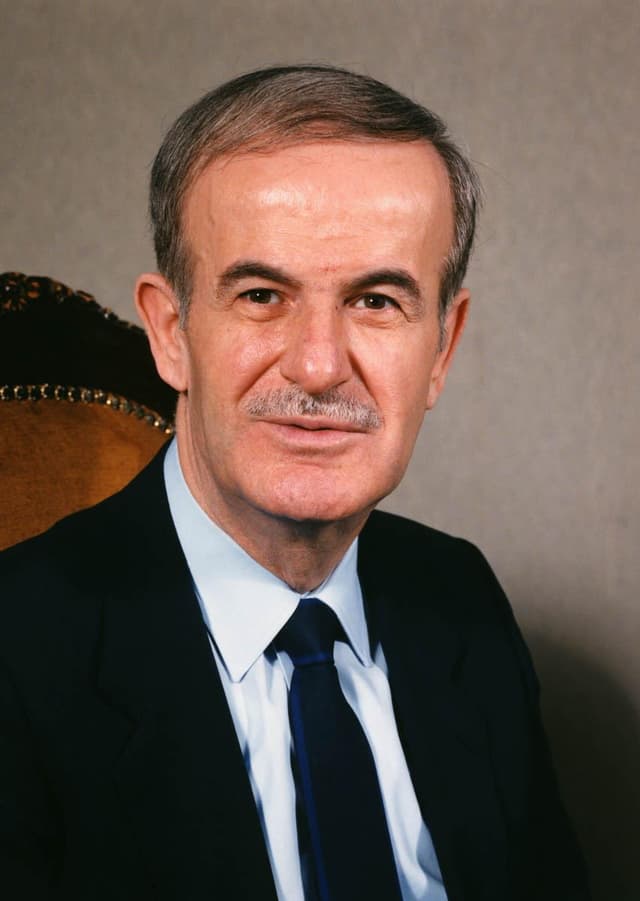
Government of Syria, Public domain, via Wikimedia Commons
58/100
ACE Score: 58/100
Medium on the scale. An index, not a percentage.
75High
How total and coercive the leader’s power was.
50Medium
How devoted to and dependent on the leader followers became.
50Medium
How hard it was to leave.
(rule-based):Pattern: a closed system with little institutional restraint, where harm was aimed mainly at outsiders. A label for these scores, not a forecast. The summary and caveats describe what actually happened.
Scores are an interpretation of published sources using the ACE scoring guide, not findings of fact. Inclusion does not classify anyone as a cult. Disclaimer
Hafez al-Assad, an air force officer, took power in Syria in a 1970 coup and ruled for thirty years. He built a state run through overlapping intelligence agencies, the Ba'ath Party and an army whose key units were led by trusted relatives and fellow Alawites. His image filled public spaces and slogans called him leader forever. In 1982 his forces crushed an Islamist uprising in Hama, killing many thousands of people, most of them civilians. He arranged for his son Bashar to succeed him.
In academic terms, assad combined high epistemic and existential closure with a ritualised cult that demanded public compliance rather than belief, while keeping power personal and familial, so routinization stayed low despite a large state apparatus.
Where scholars disagree
The case that the framework fits
Scholars such as Wedeen show a cult of personality enforced by fear, compulsory ritual praise and mass violence at Hama, which fits a model of binding through complicity and terror.
The case that it does not fit, or overstates
Patrick Seale and others stress that Assad was a cautious pragmatist who brought stability after years of coups, and some Syrians, especially minorities, saw his rule as protection against sectarian war. Most Syrians related to him through patronage and fear, not devotion, and the regime had no transformative ideology comparable to Nazism or Stalinism, which is why it is classed here as an authoritarian rather than a totalitarian regime.
The five walls
5.6 of 10
- 7
1.
Who decides what is real?
The press and broadcasting were state controlled and criticism of the president was a security matter handled by the mukhabarat (intelligence services). Lisa Wedeen documents how citizens were required to repeat official slogans and praise in public whether or not they believed them.
- 4
2.
Are friends and family outside the group cut off?
Family life was not reorganised by the state, but informant networks reached into workplaces and neighbourhoods. Relatives of suspected Islamists and leftists were detained or harassed as a form of pressure.
- 6
3.
How hard is it to physically leave?
Travel abroad required security clearance and many dissidents and their relatives were banned from leaving. Opponents were held for years without trial in prisons such as Tadmor (Palmyra).
- 3
4.
Is an apocalypse or a destined triumph always near?
Ba'athist ideology promised Arab unity and national resurrection on a long horizon. Confrontation with Israel framed politics, but there was no dated or imminent end.
- 8
5.
Does the group decide who deserves to live?
In February 1982 the army and special units commanded by his brother Rifaat besieged Hama, killing an estimated 5,000 to 40,000 people according to human rights groups and journalists. On 27 June 1980, the day after an attempt on Assad's life, troops killed an estimated 500 to 1,100 Islamist prisoners at Tadmor prison.
Debt, dependence and harm
6 of 10, medium
How much do followers feel they owe?
Careers in the army, state and party depended on loyalty, and public displays of devotion such as rallies and pledges were routine. Large parts of the population depended on state employment and subsidies.
6 of 10, medium
How far does everything rest on one person?
The party, parliament and ministries existed, but real power sat with Assad and a circle of security chiefs and relatives. Succession was handled by grooming first his son Basil and, after Basil's death in 1994, his son Bashar. After Hafez died in 2000, parliament lowered the minimum age for president so that Bashar could take over.
+6, mostly outsiders
When the system turns violent, where does the harm go?
Outward: almost all lethal violence fell on groups the regime defined as enemies, above all the Muslim Brotherhood and the people of Hama, Islamist prisoners at Tadmor, leftists, and Palestinian and Lebanese opponents during Syria's long military presence in Lebanon. Inward: rival Ba'athists such as Salah Jadid were imprisoned and his brother Rifaat was pushed into exile in 1984, but few regime insiders were killed.
Methods of control
Specific techniques from the historical record that kept followers loyal and the bubble sealed.
- 01Multiple competing intelligence agencies watching each other and society
- 02Compulsory public praise and slogans in schools, media and rallies
- 03Placing relatives and trusted Alawite officers in command of elite units
- 04Collective punishment, shown most clearly at Hama in 1982
- 05Long detention without trial and torture in prisons such as Tadmor
- 06Patronage through state jobs, party membership and business licences
Against the reference cases
State power, violence aimed outward
Compared with Hitler
Like Hitler, Assad used a leader cult and mass violence against a defined enemy, but he had no expansionist race ideology and did not wage genocide.
A sealed group, violence aimed inward
Compared with Jones
Unlike Jones, Assad did not demand belief or communal living; he demanded outward compliance from a whole society and kept violence pointed at opponents rather than followers.
Through the theorists
Assad's authority was less charismatic than patrimonial: offices were distributed as personal favours, and the cult was a manufactured imitation of charisma.
Lisa Wedeen
The cult worked by making people act 'as if' they revered the leader. Public participation in obvious falsehoods created complicity and isolated people from one another.
Juan Linz
Syria under Assad mixes authoritarian and sultanistic traits: a party and bureaucracy exist, but loyalty to the ruler and his family overrides rules.
Key sources
Moderate evidence base
- Seale, Patrick (1988). Asad of Syria: The Struggle for the Middle East.
- Wedeen, Lisa (1999). Ambiguities of Domination: Politics, Rhetoric, and Symbols in Contemporary Syria.
Caveats
Syria was closed to independent research, so internal figures are scarce and casualty numbers for Hama vary widely. Seale's biography drew on access to Assad and is seen by some as sympathetic. Violence and repression peaked in 1979 to 1982 and were lower in the 1990s. Under the regime rule, Syrian opponents and the population of Hama count as outward because the regime defined them as enemies; the few purges of insiders count as inward.
Cite this profile
Koziol, T. (2026). Hafez al-Assad. In ACE: Authority, Cult & Exit (Version 1.1, pilot database). Ceraluna Labs. https://cultornot.com/leader/hafez-al-assad