From the ACE database. Researched and checked against published sources.
Muammar Gaddafi
1942 to 2011, army officer who seized power in September 1969 and ruled Libya until he was killed in October 2011
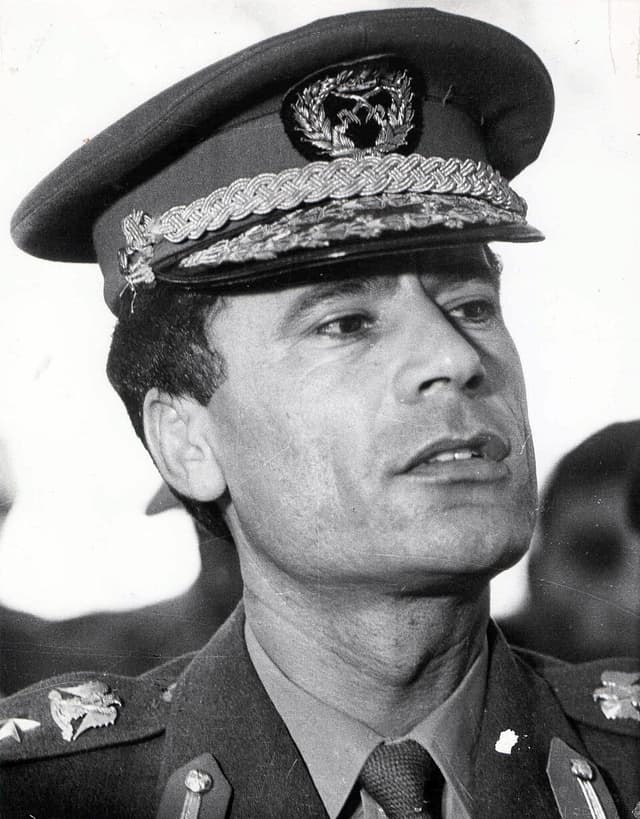
Stevan Kragujević, CC BY-SA 3.0, via Wikimedia Commons
65/100
ACE Score: 65/100
Medium on the scale. An index, not a percentage.
80High
How total and coercive the leader’s power was.
60Medium
How devoted to and dependent on the leader followers became.
55Medium
How hard it was to leave.
(rule-based):Pattern: a closed system with little institutional restraint, where harm was aimed mainly at outsiders. A label for these scores, not a forecast. The summary and caveats describe what actually happened.
Scores are an interpretation of published sources using the ACE scoring guide, not findings of fact. Inclusion does not classify anyone as a cult. Disclaimer
Gaddafi was a young army officer who overthrew the Libyan monarchy in 1969. He set out his political philosophy in the Green Book and in 1977 declared Libya a 'Jamahiriya', a 'state of the masses' run by people's congresses, while real power stayed with him and his Revolutionary Committees. Students and opponents were publicly hanged, exiles abroad were hunted as 'stray dogs', and about 1,200 prisoners were killed at Abu Salim prison in 1996. Libya was also linked to attacks abroad, including the 1988 Lockerbie bombing. He was overthrown and killed in the 2011 uprising.
In academic terms, gaddafi built an ideological cult around a text and a claim of statelessness, which let him hold total power while holding no office; closure was high and violence pointed both at internal dissent and at foreign targets.
Where scholars disagree
The case that the framework fits
The Green Book as scripture, the cult of the 'Brother Leader' and the punishment of whole families fit a high-control, leader-centred system.
The case that it does not fit, or overstates
Dirk Vandewalle stresses that the regime relied on oil rents and tribal bargains, and that its 'statelessness' reflected a weak state rather than an all-seeing one. Some Libyans supported Gaddafi as an anti-colonial and pan-Arab figure.
The five walls
6.2 of 10
- 8
1.
Who decides what is real?
The Green Book was compulsory study in schools and its slogans covered public walls. All media were state-run, and Law 71 of 1972 made forming or joining any group opposed to the revolution punishable by death.
- 5
2.
Are friends and family outside the group cut off?
Revolutionary Committees recruited informers in schools and workplaces. A 1997 'Charter of Honour' allowed collective punishment of families and tribes for an individual's dissent.
- 6
3.
How hard is it to physically leave?
Travel abroad was restricted at times, and exiles were tracked and assassinated in Europe in the 'stray dogs' campaign of the early 1980s. Libya faced international sanctions and isolation in the 1990s.
- 4
4.
Is an apocalypse or a destined triumph always near?
The Green Book presented a 'Third Universal Theory' as the definitive answer to the problem of government, beyond capitalism and communism. This historical-destiny framing shaped official life but set no end date.
- 8
5.
Does the group decide who deserves to live?
From 1977 students and dissidents were publicly hanged, some on television. In 1996 about 1,200 prisoners were killed at Abu Salim prison in Tripoli.
Debt, dependence and harm
6 of 10, medium
How much do followers feel they owe?
Most Libyans depended on state jobs and subsidies funded by oil, and attendance at people's congresses and loyalty displays was expected. Revolutionary Committee members took part in trials and executions.
8 of 10, high
How far does everything rest on one person?
Gaddafi held no formal post after 1979 yet decided everything, and his sons and security chiefs ran parallel structures. There was no recognised succession mechanism.
+7, mostly outsiders
When the system turns violent, where does the harm go?
Outward violence dominates: the 1988 Lockerbie bombing that killed 270, the 1989 UTA Flight 772 bombing, the war in Chad, and, under the regime rule, the killing of dissidents, Islamist prisoners at Abu Salim and exiles abroad. Executions of army officers after failed coup attempts, such as those of 1975 and 1993, count as inward.
Methods of control
Specific techniques from the historical record that kept followers loyal and the bubble sealed.
- 01Compulsory Green Book study and slogans
- 02Revolutionary Committees as ideological police
- 03Public executions, some televised
- 04Collective punishment of families and tribes
- 05Assassination of exiles abroad
- 06Oil-funded state employment and subsidies
Against the reference cases
State power, violence aimed outward
Compared with Hitler
Like Hitler, Gaddafi used a founding text and a revolutionary movement to bypass the state, but his foreign violence was terrorism and limited wars, not conquest or genocide.
A sealed group, violence aimed inward
Compared with Jones
Like Jones, he claimed to rule through the people while deciding everything personally, but Libyans kept family lives and were never asked to die together.
Through the theorists
Gaddafi tried to keep revolutionary charisma alive by refusing office and routinization, which left the state weak and dependent on him.
Lisa Anderson
Anderson explains the Jamahiriya through Libya's history of weak state-building and reliance on kinship and tribe.
Oil-funded loyalty and blocked voice kept exit and protest low until 2011, when they broke open at once.
Key sources
Strong evidence base
- Vandewalle, Dirk (2006). A History of Modern Libya.
- Pargeter, Alison (2012). Libya: The Rise and Fall of Qaddafi.
Caveats
Control and violence varied over 42 years; the late 1970s to 1990s were the peak, while the 2000s saw rapprochement with the West. Some details of internal repression come from exile and opposition sources. Most deaths fall on the outward side of the vector; purges of officers are on the inward side. He is classed as an authoritarian ruler because scholars such as Vandewalle stress a weak, personalised state rather than totalitarian control.
Cite this profile
Koziol, T. (2026). Muammar Gaddafi. In ACE: Authority, Cult & Exit (Version 1.1, pilot database). Ceraluna Labs. https://cultornot.com/leader/muammar-gaddafi