From the ACE database. Researched and checked against published sources.
Vladimir Lenin
1870 to 1924, leader of the Bolshevik faction from 1903 and head of the Soviet government from the October Revolution of 1917 until his death in January 1924
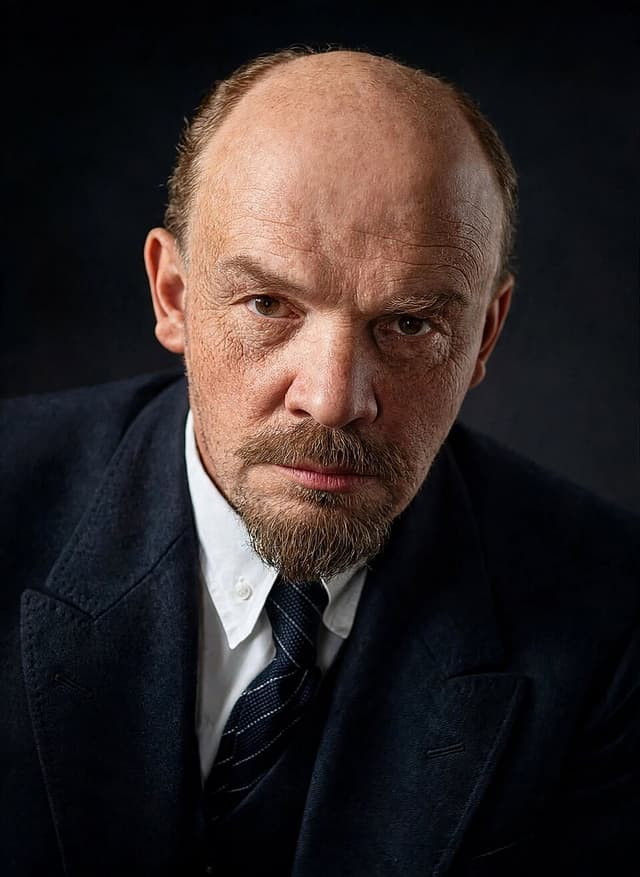
Pavel Zhukov, Public domain, via Wikimedia Commons
63/100
ACE Score: 63/100
Medium on the scale. An index, not a percentage.
80High
How total and coercive the leader’s power was.
60Medium
How devoted to and dependent on the leader followers became.
50Medium
How hard it was to leave.
(rule-based):Pattern: a closed system with little institutional restraint, where harm was aimed mainly at its own people. A label for these scores, not a forecast. The summary and caveats describe what actually happened.
Scores are an interpretation of published sources using the ACE scoring guide, not findings of fact. Inclusion does not classify anyone as a cult. Disclaimer
Lenin led the Bolsheviks to power in Russia in October 1917. His government shut opposition newspapers, dissolved the elected Constituent Assembly, and founded the Cheka secret police. During the civil war it launched the 'Red Terror' against class enemies and crushed peasant and sailor revolts. After his death his body was embalmed and put on display, and the party built a cult around him.
In academic terms, lenin built the machinery of closure (one party, a secret police, censorship and terror) but ruled more by persuasion inside the party than by personal cult, which was largely created after his death.
Where scholars disagree
The case that the framework fits
Pipes and Service argue Lenin designed the one-party state and endorsed terror as policy. Tumarkin shows how the party turned him into a near-religious figure with relics and a mausoleum.
The case that it does not fit, or overstates
Historians such as Lars Lih argue Lenin acted under the extreme pressure of civil war and that his authority inside the party rested on argument, not devotion. His personal cult was built mostly after 1924, against his widow's wishes.
The five walls
6.6 of 10
- 8
1.
Who decides what is real?
A decree of October 1917 allowed the closure of hostile newspapers, and by 1918 the opposition press was gone. In 1921 the Tenth Party Congress banned factions inside the party itself.
- 4
2.
Are friends and family outside the group cut off?
Early Soviet law made divorce easy and weakened church control of marriage. Family ties were not systematically severed, although class origin began to decide access to food and education.
- 6
3.
How hard is it to physically leave?
Borders were increasingly closed during the civil war, and travel abroad needed permission. In 1922 the regime expelled more than 200 intellectuals and their families abroad on the so-called 'philosophers' ships' rather than keep them.
- 7
4.
Is an apocalypse or a destined triumph always near?
The Bolsheviks expected world revolution to spread to Germany and beyond within months or years. The civil war was framed as the final battle between the working class and its exploiters.
- 8
5.
Does the group decide who deserves to live?
In 1918 Lenin ordered the public hanging of 'no fewer than 100' kulaks in Penza province. Estimates of Cheka executions from 1917 to 1922 range from tens of thousands to about 140,000, and revolts at Tambov and Kronstadt were crushed with mass killings.
Debt, dependence and harm
6 of 10, medium
How much do followers feel they owe?
Under War Communism, grain was seized from peasants and labour was conscripted. Party members were expected to give up personal life to the cause and obey discipline without question.
5 of 10, medium
How far does everything rest on one person?
Lenin led through the Central Committee and Politburo, where real debate still took place. He left no clear successor, and his final 'testament' warning against Stalin was read only to closed groups of delegates in 1924 and not published in the Soviet Union until 1956.
-1, little harm, or balanced
When the system turns violent, where does the harm go?
Outward: the Red Terror against class enemies, the war against the White armies, the crushing of 'kulak' and 'bandit' revolts such as Tambov, and the 1921 invasion of Georgia. Inward: the 1921 to 1922 famine, worsened by grain requisitioning, killed millions of peasants, and the Kronstadt sailors, once the regime's model supporters, were crushed in 1921.
Methods of control
Specific techniques from the historical record that kept followers loyal and the bubble sealed.
- 01Single-party rule
- 02Cheka secret police and Red Terror
- 03Closure of opposition press
- 04Ban on factions within the party
- 05Grain requisitioning and labour conscription
- 06Expulsion of intellectuals
- 07Posthumous leader cult
Against the reference cases
State power, violence aimed outward
Compared with Hitler
Both created one-party states with secret police, but Lenin governed through party debate and his cult came mostly after death, while Hitler's cult was central to his rule from the start.
A sealed group, violence aimed inward
Compared with Jones
Lenin's authority came from doctrine and organisation rather than personal spiritual claims, and most of his deliberate violence was aimed at class enemies rather than his own followers.
Through the theorists
Lenin's charisma was routinised after death into a party cult, an example of charisma turned into institutional legitimacy.
Arendt saw Lenin's rule as a revolutionary dictatorship that was not yet fully totalitarian; that step came under Stalin.
Tumarkin
The Lenin cult borrowed the forms of Orthodox saint veneration to give the new state a sacred centre.
Key sources
Strong evidence base
- Service, Robert (2000). Lenin: A Biography.
- Pipes, Richard (1990). The Russian Revolution.
- Tumarkin, Nina (1983). Lenin Lives! The Lenin Cult in Soviet Russia.
Caveats
Lenin ruled for only about six years, mostly during civil war, so peak control is hard to separate from wartime emergency. Cheka execution totals range from about 12,700 (the Cheka's own figure) to 140,000 or more. The 1921 to 1922 famine killed somewhere between about 1 and 5 million people, with drought, war and requisitioning all to blame. On the vector, Red Terror killings, the war on the Whites and the crushed peasant revolts count as outward; famine deaths among peasants and the killing of the Kronstadt sailors count as inward. Because the famine had natural causes too, the net is only slightly inward, and weighing it less would make the score outward.
Cite this profile
Koziol, T. (2026). Vladimir Lenin. In ACE: Authority, Cult & Exit (Version 1.1, pilot database). Ceraluna Labs. https://cultornot.com/leader/vladimir-lenin