From the ACE database. Researched and checked against published sources.
Nongqawuse
c. 1841 to c. 1898, prophet of the 1856–57 cattle-killing among the Xhosa, Gxarha River in independent Xhosaland
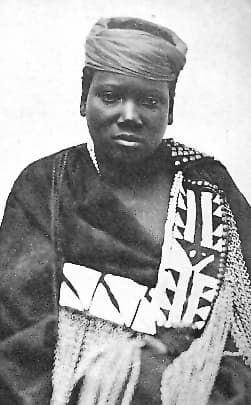
Unknown author, Public domain, via Wikimedia Commons
51/100
ACE Score: 51/100
Medium on the scale. An index, not a percentage.
35Low
How total and coercive the leader’s power was.
87High
How devoted to and dependent on the leader followers became.
30Low
How hard it was to leave.
(rule-based):Pattern: walls low enough (Bubble Score under 5) for followers to leave fairly easily. A label for these scores, not a forecast. The summary and caveats describe what actually happened.
Scores are an interpretation of published sources using the ACE scoring guide, not findings of fact. Inclusion does not classify anyone as a cult. Disclaimer
Nongqawuse was a girl of about fifteen who in 1856 reported that ancestors had told her the dead would rise and the British would be driven away if the Xhosa killed their cattle and destroyed their grain. Her uncle Mhlakaza, a diviner, spread the message, and the paramount chief Sarhili supported it. This came after decades of frontier wars, land loss and a lung-sickness epidemic that was already killing cattle. Around 400,000 cattle were killed and tens of thousands of people died of hunger, and Governor Sir George Grey used the crisis to seize land and push survivors into colonial labour.
In academic terms, the cattle-killing shows extreme temporal and debt closure, with a dated resurrection demanding the destruction of livelihoods, under a young prophet with little personal control. Scored by who suffered, the harm fell mainly on believers, deepened by colonial policy.
Where scholars disagree
The case that the framework fits
A prophecy with dated predictions led believers to destroy their means of survival, and failures were explained away by blaming unbelievers.
The case that it does not fit, or overstates
Peires reads the movement as a rational, if tragic, response to colonial pressure and cattle disease, shaped by Christian and Xhosa ideas of resurrection. Bradford and Qotole, presenting an 1888 Xhosa-language debate led by W. W. Gqoba, argue for more attention to Nongqawuse herself and to Xhosa intellectuals' own readings. Many Xhosa believe Grey engineered the prophecy, a view Peires rejects. She was a teenager and should not be treated as a cult leader in any simple sense.
The five walls
4.4 of 10
- 4
1.
Who decides what is real?
Believers were urged to trust the prophecies, and those who doubted were blamed for the failure of each predicted day. Chiefs and diviners, not Nongqawuse alone, enforced the message.
- 5
2.
Are friends and family outside the group cut off?
Society split between believers (amathamba) and unbelievers (amagogotya), dividing families and chiefdoms. Unbelievers were blamed and sometimes driven out.
- 1
3.
How hard is it to physically leave?
There was no physical confinement, though famine and colonial labour policies later forced survivors to move into the Cape Colony.
- 9
4.
Is an apocalypse or a destined triumph always near?
Specific days were set for the resurrection, when the sun would rise red and the dead return, including February 1857. People killed cattle and stopped planting in expectation.
- 3
5.
Does the group decide who deserves to live?
Unbelievers were said to block the prophecy and some were threatened. There was no systematic violence against them.
Debt, dependence and harm
9 of 10, high
How much do followers feel they owe?
Believers killed their cattle and destroyed grain, the foundation of Xhosa wealth and social life. Survival came to depend entirely on the promised resurrection.
8 of 10, high
How far does everything rest on one person?
Mhlakaza, Sarhili and other chiefs shaped and spread the movement, but it had no lasting structure and ended with the famine.
-6, mostly insiders
When the system turns violent, where does the harm go?
Peires estimates about 40,000 deaths from starvation, mostly among believers and their families. Nobody was killed by the movement; the deaths came from famine after the prophecy, made worse when colonial officials limited relief and tied aid to colonial labour.
Methods of control
Specific techniques from the historical record that kept followers loyal and the bubble sealed.
- 01Ancestral prophecy relayed through a young seer
- 02Dated predictions of resurrection
- 03Destruction of cattle and grain as proof of faith
- 04Blaming unbelievers for failed predictions
- 05Endorsement by chiefs and diviners
Against the reference cases
State power, violence aimed outward
Compared with Hitler
No meaningful parallel: the movement did no violence to outsiders, and its tragedy unfolded under colonial domination.
A sealed group, violence aimed inward
Compared with Jones
Like Jonestown, the deaths fell on believers, but they came through famine after a prophecy, not by a leader's order, and colonial policy deepened them.
Through the theorists
Nongqawuse's charisma was largely conferred by elders and chiefs who controlled how her visions were used.
Wallace
The movement fits Wallace's model of a revitalization movement in a society under severe stress from war, land loss and disease.
Peires
Peires argues the movement drew on a coherent belief system and should be seen as a response to colonial crisis, not irrational delusion.
Key sources
Moderate evidence base
- Peires, J. B. (1989). The Dead Will Arise: Nongqawuse and the Great Xhosa Cattle-Killing Movement of 1856–7.
- Bradford, Helen, and Msokoli Qotole (2008). Ingxoxo enkulu ngoNongqawuse (A Great Debate about Nongqawuse's Era).
Caveats
Sources are largely colonial records, missionary accounts and later Xhosa oral tradition, and Nongqawuse's own words survive only through others. The debate over Grey's role and the colonial context is ongoing. Scores treat the movement as a whole and should not be read as blaming a teenager for mass death.
Cite this profile
Koziol, T. (2026). Nongqawuse. In ACE: Authority, Cult & Exit (Version 1.1, pilot database). Ceraluna Labs. https://cultornot.com/leader/nongqawuse