From the ACE database. Researched and checked against published sources.
Osama bin Laden
1957 to 2011, founder and leader of al-Qaeda, based in Afghanistan, Sudan and finally Pakistan
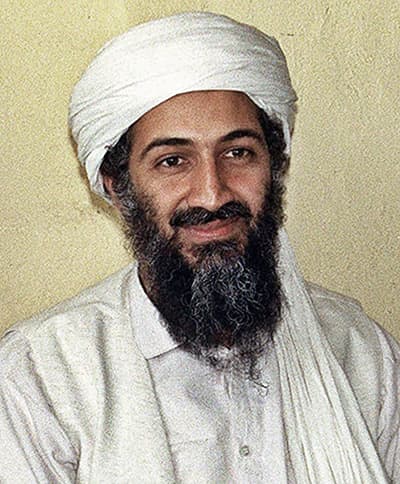
Hamid Mir, CC BY-SA 3.0, via Wikimedia Commons
52/100
ACE Score: 52/100
Medium on the scale. An index, not a percentage.
65Medium
How total and coercive the leader’s power was.
50Medium
How devoted to and dependent on the leader followers became.
40Medium
How hard it was to leave.
(rule-based):Pattern: a closed system with strong offices, rules and succession. A label for these scores, not a forecast. The summary and caveats describe what actually happened.
Scores are an interpretation of published sources using the ACE scoring guide, not findings of fact. Inclusion does not classify anyone as a cult. Disclaimer
Bin Laden was a wealthy Saudi who joined the war against the Soviet occupation of Afghanistan and founded al-Qaeda in 1988. Members swore a personal oath of allegiance to him and trained in camps in Afghanistan. Al-Qaeda bombed US embassies in Kenya and Tanzania in 1998 and carried out the 11 September 2001 attacks, which killed nearly 3,000 people. He hid for almost ten years and was killed by US forces in Abbottabad, Pakistan, in 2011.
In academic terms, bin Laden bound followers through an oath, camp life and a cosmic-war narrative, but al-Qaeda never held members in a sealed space, so its closures are moderate while its existential score and outward vector are high.
Where scholars disagree
The case that the framework fits
Wright and Bergen describe a personal following built on bin Laden's piety, wealth and austerity, and an oath that bound members to him personally, which fits a charismatic-binding model.
The case that it does not fit, or overstates
Lahoud's reading of the Abbottabad papers shows a leader who after 2001 had little control over affiliates and struggled to keep in touch with them. Many scholars treat al-Qaeda as a political-military network, not a cult.
The five walls
5.2 of 10
- 5
1.
Who decides what is real?
Training camps delivered intensive religious and political indoctrination and portrayed Western and Arab media as enemy propaganda, but members could still read, travel and argue.
- 4
2.
Are friends and family outside the group cut off?
Members often lived with their own families; bin Laden encouraged marriages within the network, but there was no systematic break with relatives.
- 4
3.
How hard is it to physically leave?
Camps in Afghanistan were remote and guarded, yet members did leave; Jamal al-Fadl defected in 1996 and testified for the US government.
- 5
4.
Is an apocalypse or a destined triumph always near?
Bin Laden framed a long defensive war between Islam and a Western-Zionist alliance, but he did not set a date for the end, and McCants notes he distanced al-Qaeda from end-times talk.
- 8
5.
Does the group decide who deserves to live?
Al-Qaeda declared killing Americans and their allies a religious duty in 1998 and carried out mass-casualty attacks, including the 2001 attacks.
Debt, dependence and harm
6 of 10, medium
How much do followers feel they owe?
Recruits swore a personal oath (bay'a) to bin Laden; some gave up careers and homes, and suicide operatives gave their lives, but most members kept property and family.
4 of 10, medium
How far does everything rest on one person?
Al-Qaeda had a shura council and committees for military, finance and media, and Ayman al-Zawahiri succeeded bin Laden in 2011.
+8, mostly outsiders
When the system turns violent, where does the harm go?
Violence was directed outward against civilians and governments in many countries; there was little violence against members.
Methods of control
Specific techniques from the historical record that kept followers loyal and the bubble sealed.
- 01Personal oath of allegiance (bay'a)
- 02Indoctrination in training camps
- 03Cosmic-war narrative of a besieged Muslim community
- 04Glorification of martyrdom
- 05Use of personal wealth and patronage
- 06Media statements that built a global persona
Against the reference cases
State power, violence aimed outward
Compared with Hitler
Unlike Hitler, bin Laden never governed a state; his reach came through a dispersed network and media, not a party-state.
A sealed group, violence aimed inward
Compared with Jones
Unlike Jones, bin Laden did not keep followers in a sealed compound or turn violence inward on them.
Through the theorists
Bin Laden's authority was charismatic and religious, but al-Qaeda's council and its succession by Zawahiri show partial routinization.
Mark Juergensmeyer
His war was a cosmic struggle in which ordinary moral limits on killing were suspended.
Marc Sageman
Sageman's network approach stresses friendship and kinship ties among recruits more than top-down control by a leader.
Key sources
Strong evidence base
- Wright, Lawrence (2006). The Looming Tower: Al-Qaeda and the Road to 9/11.
- Lahoud, Nelly (2022). The Bin Laden Papers: How the Abbottabad Raid Revealed the Truth about al-Qaeda, Its Leader and His Family.
Caveats
Control was highest in the Afghan camp period of 1996 to 2001 and weak after that. Much evidence comes from interrogations and intelligence sources. The scores describe al-Qaeda's core, not its regional affiliates.
Cite this profile
Koziol, T. (2026). Osama bin Laden. In ACE: Authority, Cult & Exit (Version 1.1, pilot database). Ceraluna Labs. https://cultornot.com/leader/osama-bin-laden