From the ACE database. Researched and checked against published sources.
Velupillai Prabhakaran
1954 to 2009, founder and sole leader of the LTTE, which ran a de facto state in northern and eastern Sri Lanka
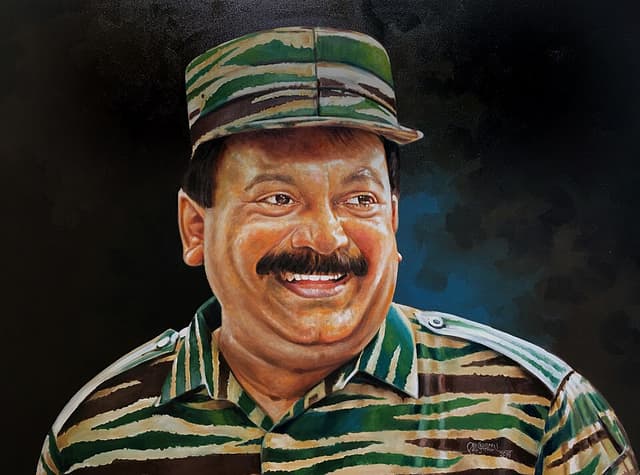
Rajasekharan Parameswaran, CC BY-SA 4.0, via Wikimedia Commons
67/100
ACE Score: 67/100
Medium on the scale. An index, not a percentage.
75High
How total and coercive the leader’s power was.
60Medium
How devoted to and dependent on the leader followers became.
65Medium
How hard it was to leave.
(rule-based):Pattern: a closed system with little institutional restraint, where harm was aimed mainly at outsiders. A label for these scores, not a forecast. The summary and caveats describe what actually happened.
Scores are an interpretation of published sources using the ACE scoring guide, not findings of fact. Inclusion does not classify anyone as a cult. Disclaimer
Prabhakaran founded the Tamil New Tigers in 1972 and renamed them the LTTE in 1976, fighting for an independent Tamil state. He turned the LTTE into the dominant Tamil armed group by destroying rival Tamil militias, and by the 2000s it ran police, courts and taxes in the territory it held. Fighters carried cyanide capsules to take if captured, and a suicide unit, the Black Tigers, carried out attacks from 1987. The movement collapsed when the Sri Lankan army defeated it in May 2009 and Prabhakaran was killed.
In academic terms, prabhakaran built high debt and existential closure through a martyrdom economy (the cyanide capsule, Heroes' Day, the Black Tigers) while keeping authority so personal that the LTTE did not survive his death. Its violence ran mainly outward, against the state, civilians and rival Tamils, but turned inward on its own population in the final war.
Where scholars disagree
The case that the framework fits
Writers such as Narayan Swamy describe an intense personality cult, total personal loyalty and a death-oath culture that fit a high-control profile. The cyanide capsule and Black Tigers show binding through sacrifice.
The case that it does not fit, or overstates
Others stress that the LTTE was a nationalist insurgency with a mass base rooted in real discrimination and state violence, and that its discipline resembles other guerrilla armies more than a cult. Much of its support was political, not devotional.
The five walls
6.4 of 10
- 7
1.
Who decides what is real?
The LTTE controlled media in its territory and treated criticism of the leader as treason; Tamil dissidents, journalists and rival politicians were killed, including in the diaspora.
- 6
2.
Are friends and family outside the group cut off?
Early cadres were forbidden to marry, and later marriage needed the movement's permission; the LTTE recruited children from the 1980s, and in its final years Human Rights Watch documented a policy demanding one recruit from every family in the Vanni.
- 7
3.
How hard is it to physically leave?
The LTTE ran a pass system that restricted civilians leaving the Vanni; in 2009 it fired on civilians trying to flee to government lines, as documented by Human Rights Watch and the UN Panel of Experts.
- 4
4.
Is an apocalypse or a destined triumph always near?
The ideology was a national-liberation destiny centred on a future Tamil Eelam and the sacred memory of martyrs, not an apocalyptic end of the world.
- 8
5.
Does the group decide who deserves to live?
The LTTE assassinated Rajiv Gandhi in 1991 and Sri Lankan President Premadasa in 1993, massacred Sinhalese and Muslim villagers, expelled the Muslim population of the north in 1990, and executed suspected traitors.
Debt, dependence and harm
8 of 10, high
How much do followers feel they owe?
Cadres swore loyalty to Prabhakaran personally and wore a cyanide capsule as a sign that their lives belonged to the cause; families of fallen fighters were bound to the movement through the cult of the martyrs.
6 of 10, medium
How far does everything rest on one person?
The LTTE built a police force, courts, a bank and a civil administration, but every major decision depended on Prabhakaran, and no successor or mechanism outlived his death in 2009.
+7, mostly outsiders
When the system turns violent, where does the harm go?
Most LTTE violence targeted the Sri Lankan state, civilians of other communities and rival Tamil groups; forced recruitment and the use of trapped civilians as a shield in 2009 add serious harm to its own people.
Methods of control
Specific techniques from the historical record that kept followers loyal and the bubble sealed.
- 01Cyanide capsule worn by every cadre
- 02Annual Heroes' Day martyr commemoration
- 03Elimination of rival Tamil groups
- 04Forced and child recruitment
- 05Pass system restricting exit from controlled territory
- 06Personal loyalty oath to the leader
Against the reference cases
State power, violence aimed outward
Compared with Hitler
Like Hitler, Prabhakaran was the undisputed centre of a militarised nationalist movement with a strong leader cult, but he governed a small rebel territory, not a great power.
A sealed group, violence aimed inward
Compared with Jones
Unlike Jones, Prabhakaran's violence went mainly outward, though the cyanide capsule shows a similar readiness to treat followers' deaths as loyalty.
Through the theorists
Prabhakaran's authority stayed charismatic and personal; the LTTE's administration never acquired authority independent of him.
Robert Pape
Pape treats the LTTE as a leading case of suicide terrorism used strategically by a nationalist group against an occupying state.
Mia Bloom
Bloom reads LTTE suicide attacks partly as competition for support among Tamil groups and as a product of martyr culture.
Key sources
Moderate evidence base
- Narayan Swamy, M. R. (2003). Inside an Elusive Mind: Prabhakaran.
- Weiss, Gordon (2011). The Cage: The Fight for Sri Lanka and the Last Days of the Tamil Tigers.
Caveats
Sources are polarised between Sri Lankan state narratives and Tamil nationalist accounts. Control rose sharply over time and peaked in the final siege of 2009. The Sri Lankan army also committed grave abuses, which this profile does not score.
Cite this profile
Koziol, T. (2026). Velupillai Prabhakaran. In ACE: Authority, Cult & Exit (Version 1.1, pilot database). Ceraluna Labs. https://cultornot.com/leader/velupillai-prabhakaran